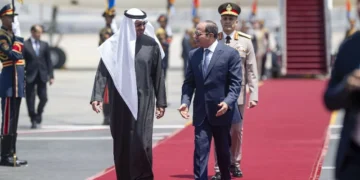





The geopolitical dynamics of the Middle East and North Africa are undergoing a rapid alignment as traditional regional powers forge deeper strategic partnerships. In a high-profile diplomatic reception at Al-Ittahadiya Palace in Cairo, Egyptian President Abdel Fattah El-Sisi received His Highness Sheikh Mohamed bin Zayed Al Nahyan, the President of the United Arab Emirates and Ruler of Abu Dhabi. This critical fraternal visit emphasizes the growing momentum behind egypt uae bilateral relations as both countries navigate shared economic, political, and security challenges.
The formal state reception commenced at Cairo International Airport, where President El-Sisi personally welcomed the UAE leader and his senior accompanying delegation. The two heads of state then proceeded to the presidential palace for an expanded session of bilateral discussions and a high-level ministerial lunch. This meeting follows a sequence of continuous diplomatic consultations between Cairo and Abu Dhabi aimed at stabilizing regional trade corridors and security architectures.
During the official talks, President El-Sisi underscored the deeply rooted strategic nature of the partnerships that define egypt uae bilateral relations across various sectors. He reiterated Egypt’s unwavering position regarding the sovereignty and territorial integrity of the United Arab Emirates against external regional threats. The Egyptian leader reasserted that the national security of the Gulf cooperation countries remains a vital, inseparable component of Egypt’s own defensive doctrine.
The economic ties between Cairo and Abu Dhabi have expanded significantly over recent fiscal cycles, turning the UAE into one of Egypt’s premier foreign investors. Beyond sovereign defense agreements, both states are aggressively exploring how egypt uae bilateral relations can drive multi-billion-dollar investments in infrastructure development, maritime logistics, and renewable energy grids. This intensive economic integration allows private companies to scale operations safely within an increasingly integrated regional business environment.
The growing commercial alignment between the two nations is also sparking a major wave of technical innovation and job creation. Joint ventures in advanced cloud architecture, smart city logistics, and telecommunications are opening up highly lucrative engineering jobs across the Nile delta. By deploying synchronized maritime tracking software across Mediterranean and Red Sea ports, both governments seek to reduce shipping friction and enhance trade velocity.
Advancing Regional Peace Through Egypt UAE Bilateral Relations
For global analysts monitoring Middle Eastern politics, this high-level Cairo summit provides a clear blueprint for how intra-Arab partnerships can mitigate macro-economic volatility. The two presidents held detailed consultations on the ongoing Gaza peace negotiations and the serious implications of the wider geopolitical conflicts on international trade routes. They underscored that working to promote stability and secure maritime shipping channels remains an essential foundation for sustainable development.
The deliberate optimization of regional shipping hubs has become a focal point of egypt uae bilateral relations, as seen in recent multi-billion-dollar port consolidation deals. Major Emirati logistics firms are working closely with Egyptian state entities to upgrade container terminals along the Suez Canal, integrating modern supply-chain networks. This technical cooperation relies heavily on automated logistics software and predictive tracking systems to maximize throughput and insulate regional trade.
Furthermore, the two sides reviewed several international development initiatives aimed at improving the social economy and creating stable vocational paths for the region’s expanding youth workforce. By funding modern technical institutes and digital literacy workshops, these joint investments help young graduates secure specialized engineering positions. This structural upskilling ensures that local talent can seamlessly manage advanced data networks, boosting long-term economic resilience.
The integration of specialized computer networks and modern communication platforms across both countries highlights a shared reliance on advanced tech infrastructure backed by egypt uae bilateral relations. Administrative departments are exploring the use of unified cloud systems to manage cross-border customs declarations and financial liquid clearing processes. This collaborative modernization is paving the way for the adoption of automated ai resource management tools to detect supply-chain anomalies.
By building deep public-private partnerships, the state-backed entities are working to shield their domestic consumer markets from global food security risks and currency fluctuations. Prominent agricultural consortiums are launching massive joint cultivation projects in Egypt to cultivate staple commodities, backed by Emirati capital. These agricultural expansions directly stabilize local food distribution loops, helping protect vulnerable communities and elevating public opinion regarding state-led development programs.
Ultimately, the successful execution of these transboundary investments requires a peaceful, highly secure regional playground where capital can be deployed safely. The continuous enhancement of egypt uae bilateral relations serves as an enduring anchor for stability, showing how strategic alliances can achieve true self-reliance. As the two delegations draft final implementation schedules, this bilateral model continues to show how coordinated Arab action can drive long-term prosperity.