


By Afrikeye Editorial Desk
Some budgets manage a year. Others redefine an era.
Botswana’s latest fiscal projections firmly belong in the latter category.
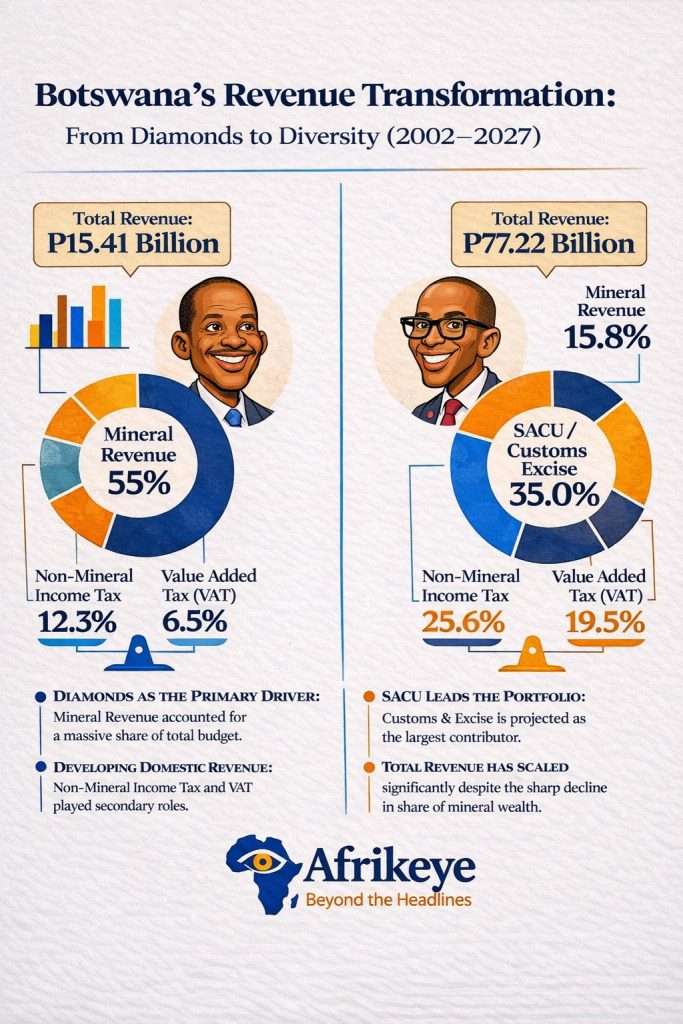
In 2002, Botswana generated P15.41 billion in total revenue, with minerals—overwhelmingly diamonds through its Debswana partnership—driving 55% of that income. Income tax contributed just 12.3%, and VAT added a modest 6.5%. Diamonds didn’t simply represent a sector; they formed the republic’s fiscal backbone.
The 2026/27 projection tells a radically different story. Botswana expects to collect P77.22 billion in total revenue, yet minerals will account for only 15.8% of that total. In contrast:
- SACU / Customs & Excise: 35.0%
- Non-Mineral Income Tax: 25.6%
- VAT: 19.5%
Domestic taxation—combining income tax and VAT—now generates roughly 45% of total government revenue.
The era of mineral dominance has quietly ended. Botswana fiscal diversification has arrived.
Finance Minister Confronts New Reality
Finance Minister Ndaba Gaolathe made the direction unmistakable when he presented the budget to Parliament. He emphasized that Botswana can no longer rely on diamonds as the primary engine of public finance and must strengthen domestic revenue mobilization to secure long-term sustainability.
That statement transcends fiscal commentary. Gaolathe acknowledges that the old model—however successful—faces structural limits.
The numbers confirm his assessment.
Automatic Wealth No Longer Guaranteed
For decades, observers celebrated Botswana as Africa’s model of resource governance. Diamond wealth financed infrastructure, education, and macroeconomic stability while the government shielded citizens from heavy tax burdens.
But global diamond markets have softened. Demand volatility, lab-grown alternatives, and inventory pressures have reduced mineral receipts. Commodity dependence now reveals its vulnerability—no longer theoretical, but visible in the revenue composition itself.
Botswana hasn’t abandoned diamonds. The country has outgrown dependence on them through strategic fiscal diversification.
Citizens Now Fund the State
When income tax contributes 25.6% and VAT nearly 20%, citizens become central to the state’s fiscal survival.
This reality transforms the social contract.
A government that its people fund must deliver visible results. Citizens intensify their expectations. Accountability sharpens. The government can no longer buffer service delivery with mineral windfalls.
Yet Botswana fiscal diversification introduces risks.
VAT-heavy systems burden consumers. Greater reliance on income taxation can dampen entrepreneurial expansion if economic growth lags. And with SACU receipts projected at 35%, Botswana now depends most heavily on regional trade for revenue—introducing a different layer of external exposure.
The country has achieved diversification. But interdependence remains.
Get Botswana budget 2026 Report
A Continental Model Emerges
From a Pan-African perspective, Botswana’s pivot carries significant weight. Across Africa, resource-dependent states grapple with the same transition—from extractive rents to productive, diversified economies.
Botswana doesn’t act from crisis. Its fiscal institutions remain comparatively strong. Its debt posture stays cautious. The government undertakes this transition from stability, not desperation.
That distinction matters profoundly.
If Botswana matches revenue diversification with economic diversification—in tourism, financial services, renewable energy, agriculture, and digital industries—the country could pioneer a blueprint for post-resource governance.
If taxation rises without parallel productivity growth, pressure will quietly build.
Standing at a Crossroads, Not in Crisis
Botswana’s revenue story no longer centers on diamonds alone.
It demonstrates adaptation.
It reflects maturity.
It tests whether a nation built on mineral wealth can evolve into a diversified, tax-anchored economy without sacrificing stability or competitiveness.
The diamond era fades as the dominant fiscal pillar.
What replaces it—and how effectively Botswana fiscal diversification succeeds—will define the nation’s next chapter.
Africa watches closely.
And once again, Botswana seizes the opportunity to lead.