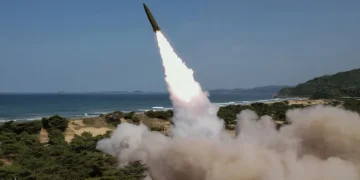





North Korea Missile Barrage 2026: Kim Jong Un Oversees Upgraded Tactical Tests
Tensions in East Asia have reached a boiling point this week after North Korea launched a significant missile barrage toward the East Sea on Sunday, April 19, 2026. This latest provocation, personally overseen by leader Kim Jong Un, marks the seventh major weapons test of the year and the fourth in the month of April alone. As the international community watches with growing concern, this missile activity highlights Pyongyang’s relentless drive to modernize its tactical nuclear capabilities. In our latest Africa News Update 2026, we analyze the strategic implications of these tests and what they mean for global security, especially for our audience in the USA and beyond.
The April 19 Launch: A Detailed Breakdown
The world was alerted early Sunday morning when South Korea’s Joint Chiefs of Staff (JCS) detected a series of short-range ballistic projectiles. According to official monitors, the North Korea missile launch originated from the Sinpo area—a region well-known for hosting the regime’s submarine yards and naval development facilities.
Technical Specifications and Range
The missiles reportedly flew approximately 140 kilometers (87 miles) at a maximum altitude of 50 kilometers before splashing down in the waters between the Korean Peninsula and Japan. While the range was relatively short, the sheer volume and frequency of the launches suggest a focus on “saturation strike” capabilities designed to overwhelm regional missile defense systems.
State media (KCNA) confirmed on Monday morning that Kim Jong Un oversaw the missile tests, specifically focusing on the upgraded Hwasong-11LA ground-to-ground tactical ballistic missiles. These new variants are reportedly equipped with cluster warheads and fragmentation mine warheads, designed for high-density destruction over a wide area.
Strategic Shift: Why the “Missile Tempo” Matters in 2026
In previous years, North Korea often timed its provocations to coincide with specific diplomatic events or holidays. However, in 2026, analysts have noted a fundamental change in Pyongyang’s behavior. The regime is no longer waiting for a reason to test; it is testing on an accelerated, internal schedule.
As noted by military analysts warning of an opportunistic nuclear push, this “tempo” is the story. By launching missiles almost weekly in April, Kim Jong Un is signaling that his nuclear program is not a bargaining chip but a permanent fixture of his national defense. This shift comes just weeks before a highly anticipated Trump-Xi summit, where Pacific security is expected to be a top agenda item.
Africa News Update 2026: Global Economic and Security Fallout
While the launches are happening in Asia, the impact is felt worldwide. In our Africa News Update 2026, we see how these regional tensions affect global supply chains and energy markets. Any instability in the Pacific directly impacts shipping routes that connect African ports to Asian markets.
Furthermore, the technology used in these missile systems often raises red flags regarding illegal arms proliferation across the Middle East and Africa. International monitors are closely watching for any signs of technology transfer that could destabilize other regions.
International Reaction: Condemnation from Seoul and Tokyo
The response from the international community has been swift and unanimous in its disapproval.
- South Korea: The Presidential Office of National Security convened an emergency meeting, condemning the launches as a clear violation of UN Security Council resolutions.
- Japan: Tokyo issued a formal protest through diplomatic channels in Beijing, calling the missile tests a threat to regional peace.
- USA: The US Indo-Pacific Command reaffirmed its “ironclad” commitment to the defense of South Korea and Japan, deploying additional surveillance assets to the region.
The Gauteng Health Department’s focus on local crises might feel worlds away, but for global business leaders, the potential for a “miscalculation” in the Korean Peninsula is a top-tier risk in our Business category.
The “Sinpo” Significance: Submarine or Land-Based?
There is ongoing debate among intelligence agencies regarding the launch platform. While Pyongyang identifies the projectiles as land-based tactical weapons, the location of Sinpo suggests they could be testing SLBM (Submarine-Launched Ballistic Missile) technology or preparing for a new naval deployment.
Earlier in April, Kim Jong Un was seen supervising strategic cruise missile tests from the Choe Hyon, a new 5,000-ton-class destroyer. The integration of nuclear-capable missiles onto naval platforms represents a significant leap in North Korea’s “second-strike” capability, making their arsenal much harder to track and destroy in a preemptive strike.
Impact on the USA and Global Defense Policy
For the target audience in the USA, these developments are a reminder of the evolving threat landscape. The Hwasong-11LA might be a short-range weapon, but the technology used to sharpen its “cluster warhead” precision is easily transferable to long-range Intercontinental Ballistic Missiles (ICBMs) that can reach the American mainland.
Defense experts are now calling for a rethink of the “Integrated Air and Missile Defense” (IAMD) strategy. As AI in defense becomes more prevalent, the ability to intercept multiple, simultaneous projectiles is the new frontier of military technology.
Conclusion: A New Era of Nuclear Brinkmanship
The April 2026 missile barrage confirms that North Korea has entered a new phase of weapons development. Kim Jong Un is no longer just testing for show; he is refining a functional, diverse, and lethal nuclear arsenal. As diplomacy remains stalled and regional tensions rise, the world must prepare for a long period of high-stakes nuclear brinkmanship.
For more updates on global security and business implications of regional conflicts, keep following Afrikeye. Explore how health protocols are being updated for emergency readiness or see the latest tech used in missile tracking. If you are planning to visit the region, check our Travel Guide for safety advisories.