The global aerospace community is currently analyzing the fallout from a historic nasa astronauts space station evacuation that has left medical experts searching for answers. Following a sudden and unexplained health crisis involving veteran astronaut Mike Fincke, the orbital laboratory saw its first-ever emergency medical repatriation. This Africa News Update 2026 brings you the latest details on how a “lightning bolt” illness disrupted mission protocols and what it means for the future of deep-space exploration.
While the incident initially unfolded in January, new reports emerging this March indicate that diagnostic teams remain baffled by the symptoms. The nasa astronauts space station evacuation has highlighted critical gaps in our ability to treat complex medical issues far from Earth’s gravity.
The Mystery Event: Why the NASA Astronauts Space Station Evacuation Happened
The drama began on January 7, 2026, during a routine dinner aboard the International Space Station. Mike Fincke, a highly experienced four-time space traveler, suddenly lost his ability to speak for approximately 20 minutes. His crewmates, witnessing the distress, immediately initiated emergency protocols and contacted flight surgeons at Johnson Space Center.
Because the station lacks the full diagnostic suite of a modern hospital, the decision was made to execute a nasa astronauts space station evacuation. Fincke described the episode as an amazingly quick event that struck with no prior warning. Although his speech returned shortly after, the potential for a recurring neurological or cardiovascular event forced a cautious early return.
The Role of SpaceX in the Medical Recovery
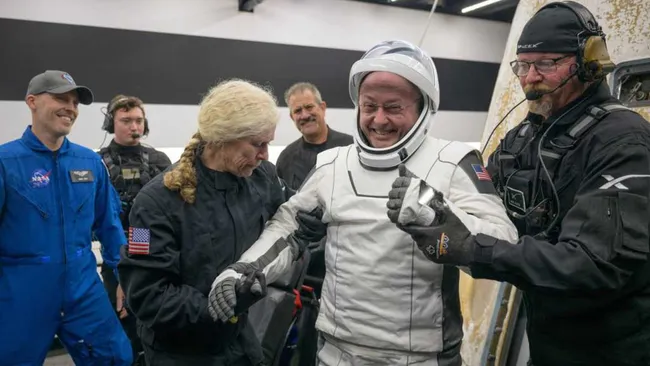
To facilitate the nasa astronauts space station evacuation, NASA utilized the SpaceX Crew Dragon capsule “Endeavour.” The spacecraft undocked on January 14 and successfully splashed down off the coast of California just 24 hours later.
All four members of Crew-11—including Zena Cardman, Oleg Platonov, and Kimiya Yui—returned home over a month ahead of schedule. Upon landing, the team was transported to Scripps Memorial Hospital to ensure comprehensive care and privacy for the affected crew member.
Medical Uncertainty and the Risks of Long-Duration Flight
Even after months of rigorous testing on Earth, doctors have yet to pinpoint the cause of the speech loss. They have officially ruled out common culprits like heart attacks or choking. This leaves “space-related physiological changes” as the primary area of investigation.
The nasa astronauts space station evacuation underscores the reality that spending over 500 days in microgravity—as Fincke has—may have cumulative effects on the human body that we do not yet fully comprehend. Experts are now reviewing historical medical records of other long-term residents of the ISS to look for similar undiagnosed patterns.
Africa’s Growing Interest in Orbital Safety
As part of this Africa News Update 2026, it is important to note how regional space agencies across the continent are monitoring these developments. Countries like South Africa, Nigeria, and Egypt are currently expanding their tech and satellite capabilities.
Ensuring the safety of human crews is a top priority for future pan-African space missions. The lessons learned from this nasa astronauts space station evacuation will likely influence the safety protocols adopted by emerging space programs in the African business and governmental sectors.
Impact on Artemis II and Future Moon Missions
One of the biggest concerns surrounding the nasa astronauts space station evacuation was its potential impact on the upcoming Artemis II mission. Artemis II is set to be the first crewed flight around the moon in over 50 years, a milestone that NASA is eager to reach without delay.
NASA Administrator Jared Isaacman has reassured the public that the ISS evacuation should not interfere with the Artemis timeline. However, the agency is now testing new AI-driven medical diagnostic tools that can be used without real-time guidance from Earth.
The Challenges of Deep Space Healthcare
Moving beyond Low Earth Orbit (LEO) means that a quick nasa astronauts space station evacuation becomes impossible. On a mission to the Moon or Mars, astronauts must be self-reliant.
- Communication Delays: Direct help from ground surgeons can take minutes or even hours.
- Limited Resupply: Specialized medical hardware must be present from day one.
- Emergency Returns: Unlike the 24-hour return from the ISS, a lunar return could take days.
Conclusion: A Lesson in Space Resilience
The nasa astronauts space station evacuation of 2026 serves as a stark reminder that the “final frontier” remains a hostile environment for the human body. While Mike Fincke is currently in stable health and continuing his reconditioning at Johnson Space Center, the mystery of his speech loss remains a significant puzzle for NASA.
As we continue to push the boundaries of human health and sports-like endurance in orbit, the data gathered from this incident will be invaluable. Stay connected with Afrikeye for the most accurate and up-to-date stories on global space exploration and AI-driven innovation.