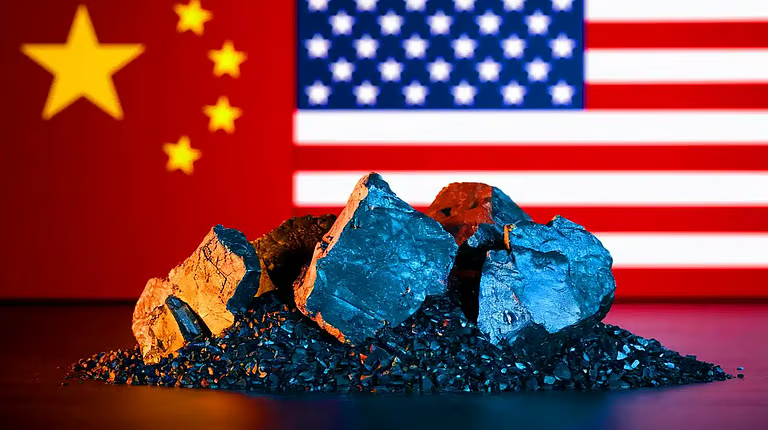
China has tightened its control over rare earth elements, a move that reignites the ongoing US-China trade dispute and raises global concerns over supply chain security. Last week, Beijing issued “Announcement No. 62 of 2025,” introducing strict export rules that could drastically limit international access to rare earths—key materials in high-tech and defense manufacturing.
These sweeping restrictions come just months after a temporary truce in the China trade relations crisis, and just ahead of a high-stakes meeting between President Donald Trump and Chinese President Xi Jinping.
China Wields Rare Earths as Trade Weapon
The announcement requires foreign companies to seek government approval to export any product containing rare earth materials—even in trace amounts—and to clearly state the product’s intended use. This puts China in a powerful position as it controls more than 70% of the world’s supply of these critical minerals, used in everything from smartphones to military jets.
“This is China versus the world,” declared U.S. Treasury Secretary Scott Bessent. “They have pointed a bazooka at the supply chains and the industrial base of the entire free world, and we’re not going to have it.”
In response, President Trump threatened an additional 100% tariff on Chinese imports and hinted at export controls on essential U.S.-made software components.
Trade Tensions Escalate Beyond Rare Earths
Both the U.S. and China have introduced new port fees on each other’s shipping vessels, escalating the already fraught China trade relations. Despite China’s Commerce Ministry assuring that export licenses will be approved for compliant, civilian-use products, American officials remain wary.
This rare earth move is widely seen as a strategic power play ahead of upcoming trade negotiations. Experts warn it gives Beijing the upper hand in setting terms.
“China’s new controls will shock the system,” said Naoise McDonagh of Edith Cowan University. “It disrupts the negotiation timeline the Americans hoped for.”
Rare earths, including neodymium and dysprosium, are essential for green energy technologies, electric vehicles, and aerospace systems. A single F-35 fighter jet requires over 400kg of rare earth elements.
Beijing’s dominance in this sector didn’t happen overnight. According to Marina Zhang from the University of Technology Sydney, China has built a world-leading R&D network and skilled workforce over years, outpacing Western rivals.
Can Other Countries Catch Up?
The U.S., Australia, and EU countries are ramping up investments in alternative rare earth supply chains, but industry experts say they are at least five years away from achieving the scale and efficiency of Chinese operations.
“Australia has resources, but its infrastructure is not yet competitive,” Zhang noted.
The timing of these new restrictions follows similar export curbs in April that triggered global shortages. Although those eased after diplomatic deals, the latest move marks a renewed tightening. China’s September export figures show a 30% drop compared to last year.
Still, analysts argue that the financial hit to China’s $18.7 trillion economy will be minimal. Rare earth exports account for less than 0.1% of GDP. Yet, their strategic value remains massive.
“These minerals are a key bargaining chip,” said NYU professor Sophia Kalantzakos. “Their economic footprint is small, but their geopolitical leverage is huge.”
US Strategy: Sanctions, Tariffs, or Concessions?
While the U.S. has accused China of “betrayal,” officials are still open to dialogue. Treasury Secretary Bessent expressed optimism for de-escalation. China’s Foreign Minister Wang Yi echoed this during a meeting with Blackstone CEO Stephen Schwarzman, calling for healthy and sustainable China trade relations.
“Effective communication is critical to resolving differences,” said Wang.
Some experts argue Washington could offer tariff relief to sway Beijing, as the trade war has significantly hurt Chinese exports. Official figures show a 27% year-on-year drop in Chinese exports to the U.S.
Others believe the U.S. may double down with more tech-focused sanctions, especially targeting semiconductors—similar to recent moves blocking China’s access to Nvidia’s high-end chips. But those measures might only slow, not stop, China’s tech ambitions.
“China has proven it’s ready to bear short-term pain for long-term gain,” said McDonagh. “But if they cut off rare earth elements, that could bring global industries to a halt. That’s a level of leverage the U.S. simply doesn’t have.”
As the US-China trade dispute heats up once again, rare earths may prove to be the critical fault line in this high-stakes geopolitical standoff.
Planning travel during uncertain global events? Visit our travel booking site for up-to-date offers and safe destinations.
This story was first reported by the BBC. Read the full article here.