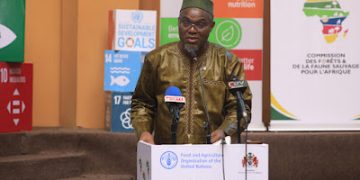





The 25th Session of the African Forestry and Wildlife Commission (AFWC25) has officially opened in Banjul, The Gambia, highlighting Africa’s commitment to sustainable forestry in African communities and advancing wildlife conservation methods. The event calls for intensified innovation and political will to protect and restore Africa’s forests and wildlife amid climate change, biodiversity loss, and increasing demand for forest products.
Hosted by the Government of The Gambia and organized by the Food and Agriculture Organization of the United Nations (FAO), the week-long conference carries the theme: Innovative and Inclusive Forest and Wildlife Resources Management for Africa. Delegates from across the continent are attending to shape policies and strategies for the coming biennium.
Strengthening Policies and Community Forestry
H.E. Muhammed B. S. Jallow, Vice President of The Gambia, welcomed participants and emphasized the country’s strong environmental stance. “The Gambia has banned timber exports, revoked illegal felling permits, and disrupted rosewood trafficking. Forest degradation has slowed, reforestation is increasing, and community forestry programmes continue to expand,” he said.
The Vice President highlighted key reforms, including the National Forest Policy (2023–2032), stronger institutions, and measures against illegal logging. He underscored the importance of partnerships, particularly with FAO, in promoting wildlife monitoring programs, mangrove restoration, biodiversity protection, and forest management capacity building.
FAO’s Role in Unlocking Africa’s Forest Potential
Abebe Haile-Gabriel, FAO Assistant Director-General and Regional Representative for Africa, praised The Gambia’s achievements and reiterated FAO’s support for African nations in strengthening sustainable forestry and wildlife systems. FAO continues to champion initiatives that transform agrifood systems, enhance environmental resilience, and support communities dependent on forest and wildlife resources.
Community-Led Forestry and Biodiversity Protection
Hon. Rohey John Manjang, Gambia’s Minister of Environment, Climate Change, and Natural Resources, highlighted that community-based forest management now covers over 30% of the country’s forests. He stressed the urgency of coordinated action to address climate change, wildfires, land degradation, and biodiversity loss, all of which affect livelihoods and agrifood systems.
Key Initiatives and Programs
Pierre Taty, Chairperson of the Committee on Forestry (COFO), outlined continental priorities, including the Sustainable Wildlife Management Programme supporting over 400 million people reliant on wild meat. While African nations have pledged to restore over 100 million hectares of degraded land, less than 9% has been restored, emphasizing the need for accelerated action through the UN Decade for Afforestation and Reforestation (2027–2036).
Delegates at AFWC25 are examining:
-
Sustainable management of forests and wildlife, including in Small Island Developing States
-
Innovative financing mechanisms for forestry and wildlife
-
Forest-based bioeconomy approaches
-
Strengthening cross-sectoral linkages for resilient agrifood systems
Parallel events during the Ninth African Forestry and Wildlife Week (AFWW9) showcase national achievements, innovative community forestry models, ecosystem restoration, and practical solutions adaptable across Africa. Field excursions provide delegates with first-hand insights into forestry and wildlife initiatives.
AFWC25 runs from 1–5 December 2025 in Banjul, The Gambia. Established in 1959, the African Forestry and Wildlife Commission provides a platform for African countries to review progress, share experiences, and guide FAO’s technical support for sustainable forestry in African communities and wildlife monitoring programs.
For more information, visit the AFWC25 website. Explore opportunities and foster partnerships through Afrikeye Travel.
This story was first reported by FAO. Read the full article here.