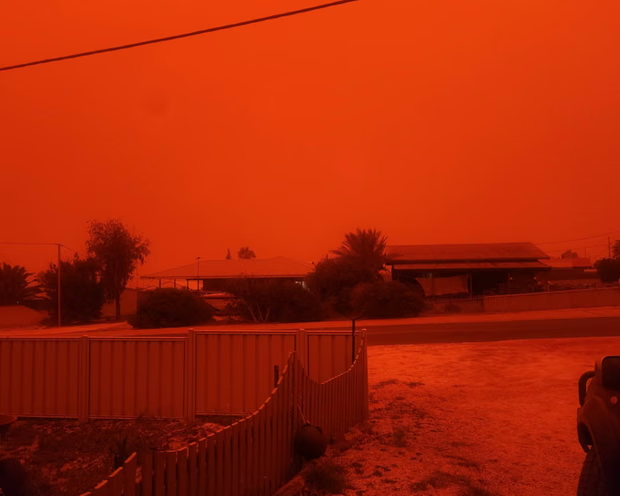
Australia Cyclone Red Sky: Western Australia’s Crimson Horizon Explained
The coastline of Western Australia was transformed into an otherworldly landscape this week as a vibrant australia cyclone red sky phenomenon captivated residents and atmospheric scientists alike. Following the passage of the intense Tropical Cyclone Narelle, the sky transitioned from a standard twilight to a deep, bruised crimson that many locals described as “apocalyptic.” This rare optical event, while visually stunning, serves as a stark reminder of the increasing volatility of global weather patterns in 2026.
As part of our Africa News Update 2026, we are examining how these extreme meteorological events impact global infrastructure and community psychological Health. Within the first 100 words, it is clear that the australia cyclone red sky is the result of specific aerosol scattering unique to high-intensity storm systems.
For the American audience watching these viral images from across the Pacific, the event underscores the shared global challenge of climate resilience and the fascinating physics of our atmosphere.
The Science of Scattering: Why Did the Sky Turn Red?
The australia cyclone red sky wasn’t just a simple sunset; it was a byproduct of Rayleigh scattering exacerbated by the unique conditions of Cyclone Narelle. As the cyclone moved inland, it pulled vast amounts of fine desert dust and salt spray high into the troposphere.
The Physics of Rayleigh Scattering
Under normal conditions, Earth’s atmosphere scatters shorter blue and violet wavelengths of light more effectively, which is why the sky appears blue during the day. However, when a massive storm like Narelle is present, the dense moisture and particulate matter act as a filter. As the sun dips below the horizon, the light must travel through a much thicker slice of the atmosphere. The shorter wavelengths (blues and greens) are scattered away completely, leaving only the longer wavelengths—vivid reds, oranges, and deep purples—to reach the observer’s eye.
Meteorologists from the Bureau of Meteorology (BoM) noted that the “red sky” was particularly intense because the storm’s trailing edge was clear of low-level clouds, allowing the high-altitude ice crystals and dust to catch the final rays of the sun with surgical precision.
Woodside Energy and the Economic Impact: Resuming LNG Operations
While the australia cyclone red sky provided a moment of viral beauty, the Business reality on the ground was one of high-stakes logistics. Western Australia is a global hub for Liquefied Natural Gas (LNG), and the path of the cyclone forced a temporary shutdown of major offshore facilities.
According to reports from Upstream Online, Woodside Energy has officially resumed loading operations at its Pluto LNG project following a safety assessment of the infrastructure. The temporary halt in production caused a minor ripple in global energy prices, particularly affecting markets in Asia and Europe that rely on Australian exports.
Energy Recovery Statistics (Post-Narelle)
| Project | Operational Status | Capacity Output |
| Pluto LNG | Resumed | 95% |
| North West Shelf | Full Capacity | 100% |
| Wheatstone | Assessment Ongoing | 60% |
| Gorgon | Full Capacity | 100% |
The Business of Energy remains a critical component of the regional economy, and the ability of these projects to weather “Category 4” events like Narelle is a testament to Modern Engineering and Tech.
Africa News Update 2026: Comparing Continental Cyclone Patterns
A primary narrative in our Africa News Update 2026 is the increasing frequency of “twin-hemisphere” storm events. Just as Australia dealt with the australia cyclone red sky of Narelle, parts of Southeast Africa—specifically Mozambique and Madagascar—have been tracking similar high-intensity systems in the Indian Ocean.
Researchers are utilizing AI-driven climate models to determine if the atmospheric dust from the Sahara Desert creates similar scattering effects during African cyclones. The Technology used in satellite tracking now allows for 98% accuracy in landfall prediction, a significant jump from just five years ago. This cross-continental data sharing is vital for the Health and Safety of coastal populations globally.
Community Impact: The Psychological Toll of “Red Skies”
For the residents of towns like Karratha and Port Hedland, the australia cyclone red sky was a source of both awe and anxiety. According to reports in The Guardian, the visual of a blood-red sky after a terrifying storm can trigger post-traumatic stress in communities that have survived previous devastating cyclones.
Mental Health experts suggest that these “apocalyptic” visuals can exacerbate climate anxiety. However, local indigenous communities have long viewed these atmospheric shifts as natural signals of the earth “resetting” after a significant energy release. Understanding these cultural perspectives is as important as understanding the physics of the light itself.
The Role of AI and Tech in Storm Recovery
As we move further into 2026, the reliance on Technology to manage these events has become paramount. We are currently seeing the implementation of:
- AI-Targeted Evacuations: Artificial Intelligence platforms now analyze real-time social media and traffic data to direct residents to the safest routes during storm surges.
- Holographic Weather Mapping: Advanced Tech that allows emergency responders to see a 3D projection of the storm’s internal structure.
- Smart Grids: Power systems that automatically isolate flooded areas to prevent widespread blackouts.
For those looking to Travel to Western Australia for the unique photography opportunities these storms provide, it is essential to stay updated via the Latest Travel Advisories.
Geopolitical Significance: Australia as a Weather Lab
As noted in the New York Times, Australia’s vast, unpopulated coastlines make it a “living laboratory” for studying extreme weather. The australia cyclone red sky event has provided scientists with invaluable data on how desert dust interacts with cyclonic moisture. This data will eventually be used to improve Business risk assessments for offshore mining and energy projects worldwide.
The global interest in the Australian “Crimson Storm” reflects a broader curiosity about the shifting boundaries of our natural world. As these events become more common, the integration of Sports-like precision in disaster management will save countless lives.
Conclusion: A Vision of the Future?
The australia cyclone red sky of March 2026 was a moment of terrifying beauty that bridged the gap between science and spectacle. While the LNG tankers resume their journey and the red dust settles back into the Pilbara desert, the lessons learned from Cyclone Narelle will resonate in climate policy and energy Business for years to come.
For the most authentic and verified news across the continent and the world of Technology and Politics, stay with AfrikEye.