Africa Day 2026 arrives at a profound historical junction, serving as both a vibrant celebration of continental identity and a sobering reminder of the deep structural fractures that still persist across the region. Officially marking the founding of the Organisation of African Unity (OAU) on May 25, 1963, this annual commemoration provides an essential global platform to evaluate the continent’s progress toward complete economic, cultural, and political sovereignty. For the modern Pan-African movement, balancing optimistic cultural expressions with the harsh, day-to-day realities of governance, border security, and human rights remains an incredibly complex task within contemporary continental politics.
As the African Union pushes forward with its Agenda 2063 blueprints, the contrast between official institutional rhetoric and the lived experiences of citizens on the ground has never been more visible. The holiday is no longer just a day for symbolic flag-waving or diplomatic speeches; it has evolved into a period of intense public introspection regarding what independence truly means in the 21st century.
The Historical Promise and Modern Re-awakening
When pioneering statesmen gathered in Addis Ababa over six decades ago, their primary mission was clear: eradicate colonialism, defend the sovereignty of newly independent states, and foster deep regional integration. In 2026, while the era of traditional colonial administrations is long gone, the struggle for absolute self-determination has transitioned into the digital, financial, and structural arenas. High-level panel discussions, grassroots exhibitions, and digital forums across various capitals have emphasized that the dreams of a united, self-determined Africa are being reignited among an exceptionally connected, highly educated, and youthful population.
This modern awakening explicitly rejects historic economic dependencies. Instead, it focuses on building localized industrial capacity, processing raw commodities locally rather than exporting them cheap, and retaining generational wealth on African soil. The continent’s youth are increasingly demanding that their leaders look inward for solutions rather than relying on foreign aid packages that frequently come with restrictive geopolitical strings attached.
The Paradox of True Liberation in 2026
Despite the undeniable cultural and political progress celebrated in major urban hubs, systemic socioeconomic challenges continue to severely restrict true continental development. Decades after breaking free from external rule, the fundamental question of absolute self-sovereignty remains deeply contested. Leading academic voices and socioeconomic analysts are utilizing this anniversary to ask tough questions about macroeconomic structures, pointing out that in Africa Day 2026, the discussion over whether the continent has achieved true liberation depends heavily on its collective ability to break free from international financial constraints, fluctuating global commodity cycles, and structural sovereign debt.
True liberation cannot exist when a vast percentage of national budgets must be directed toward servicing foreign loans rather than expanding domestic infrastructure. The modern fight for freedom is found in the restructuring of global trade frameworks, the defense of digital sovereignty, and the active mitigation of food insecurity driven by climate instabilities. Without absolute economic independence, political freedom remains a fragile facade.

Friction at the Borders: The Migration Crisis in Focus
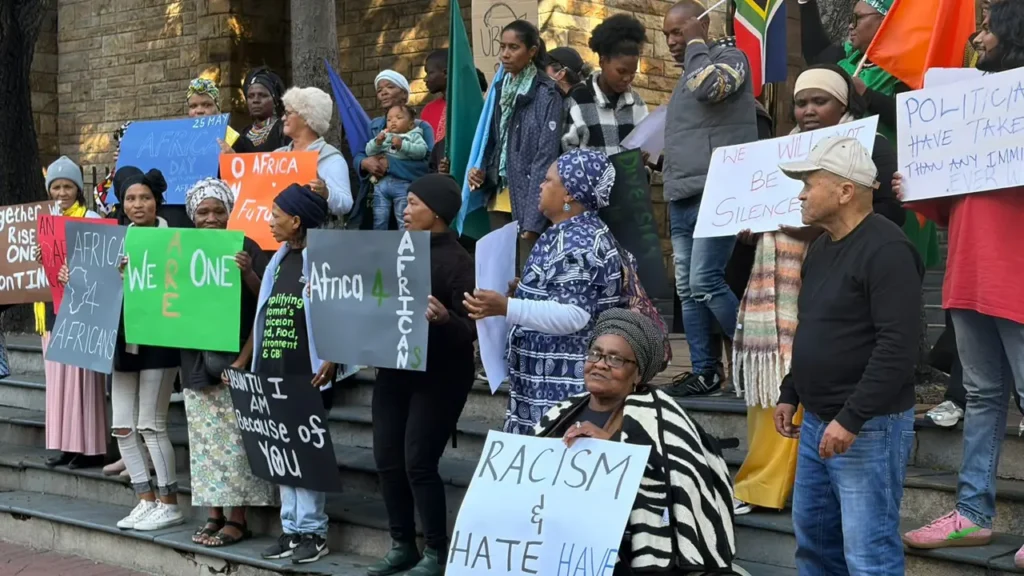
This year’s commemorations have also brought to light intense internal friction regarding cross-border migration, refugee management, and the practical execution of regional integration treaties. In South Africa, which remains a primary destination for continental migrants seeking economic refuge, the holiday was marked by highly visible, tense standoffs between humanitarian advocacy groups and localized nationalist movements.
Reports confirmed that migrant rights groups picketed for unity in Cape Town as anti-immigration protests mounted on Africa Day, demonstrating a stark, uncomfortable contrast between official Pan-African rhetoric and the actual, day-to-day experiences of African foreign nationals living in working-class communities.
These recurring localized tensions highlight the immense difficulty of managing irregular migration when municipal resources are already stretched thin. When local authorities struggle to deliver basic services, foreign nationals are frequently scapegoated, creating highly volatile environments that directly threaten local jobs and regional economic stability. Furthermore, managing the fundamental public health requirements of displaced populations in crowded informal settlements remains an exhausting logistical hurdle for provincial governments.
AfCFTA and the Economic Blueprint for Sovereignty
To transform the philosophical ideal of unity into tangible, everyday progress, African nations must aggressively prioritize the absolute success of the African Continental Free Trade Area (AfCFTA). Systematically removing rigid tariff barriers and simplifying complex customs procedures is absolutely vital to boosting intra-African commerce, stimulating private corporate business investments, and creating millions of high-quality industrial positions for the rapidly expanding youth demographic.
A thoroughly integrated market not only cushions the continent against external economic shocks but also creates a more stable environment for cross-border logistics and international travel. When goods, services, and professionals can move freely across borders without facing bureaucratic extortion or excessive delays, the entire continent benefits from accelerated industrialization.
Harnessing Technology, AI, and Cultural Ownership
Furthermore, continental institutions and private enterprises are increasingly turning to advanced digital tech and AI infrastructure to bridge historical regional logistical gaps. From optimizing cross-border fintech payment platforms to streamlining pan-African transport networks, technology is proving to be the ultimate equalizer.
Even the multi-million dollar African sports industry, along with creative music and cinematic arts sectors, is leveraging these digital advancements. By utilizing localized streaming services and independent digital networks, African creatives can now distribute their content globally and monetize their intellectual property directly, completely bypassing the exploitative distribution systems of foreign media conglomerates. True liberation in the modern era requires absolute ownership over both economic resources and cultural narratives.
Ultimately, Africa Day serves as an invaluable annual mirror, forcing the continent to acknowledge its incredible creative growth, technological innovations, and artistic triumphs alongside its unresolved systemic issues. Moving far beyond purely symbolic gestures to implement concrete structural protections, economic opportunities, and human rights guarantees for all African citizens remains the most defining challenge of this generation.
For continuous, expert coverage of iconic global sports figures, emerging regional athletic policies, and breaking transfer market updates, visit the Afrikeye homepage directly to stay ahead of the game. Our dedicated team of sports journalists delivers raw, unfiltered analysis from pitch-side to the boardroom. Additionally, you can actively participate in our highly engaging, interactive AMA sessions to share your personal opinion on the evolving landscape of South African rugby leadership. Join the fastest-growing community of passionate sports fans across the continent and make your voice heard today.