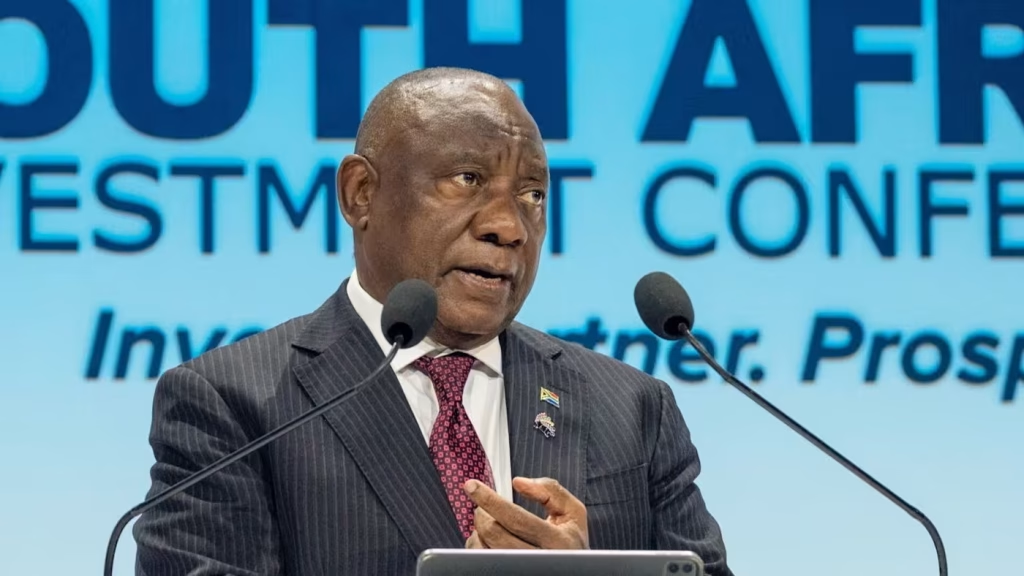
The Cyril Ramaphosa IPID Report: Damning Findings in Phala Phala Police Probe
The long-awaited Cyril Ramaphosa IPID report has officially been released, sending shockwaves through the South African political landscape. Investigative authorities have confirmed significant misconduct by high-ranking police officials during the initial investigation into the 2020 theft at President Ramaphosa’s Phala Phala farm. Within the first few pages, the Cyril Ramaphosa IPID report paints a troubling picture of state resource abuse and a deliberate attempt to conceal the crime from the public eye. This development serves as a critical Africa News Update 2026 for our USA audience tracking the stability of Africa’s largest economies.
The Independent Police Investigative Directorate (IPID) has spent months untangling the web of events surrounding the millions of dollars hidden in a sofa. Their final findings suggest that the response to the robbery was not a standard police operation but a covert effort that bypassed legal protocols. As we analyze the latest findings on the Phala Phala probe, it is clear that the repercussions will be felt far beyond the farm’s borders.
Concealed Crimes and Abused Resources: The Core Allegations
The heart of the Cyril Ramaphosa IPID report focuses on how the South African Police Service (SAPS) handled the aftermath of the theft. Instead of opening a formal criminal case, the investigation found that senior officers treated the matter as a private security issue, effectively hiding the incident for nearly two years until it was leaked by political rivals.
Misuse of the Secret Service Account (SSA)
One of the most alarming aspects of the report is the alleged misuse of police resources to track down the suspects across the border into Namibia. IPID found that funds from the Secret Service Account—money usually reserved for national security and counter-terrorism—were diverted to fund the unofficial manhunt. This bypasses the Public Finance Management Act and raises serious questions about the oversight of the Presidential Protection Service.
Disciplinary Recommendations for Senior Protectors
Accountability is the primary theme of this April 2026 release. The directorate has officially recommended disciplinary action against a senior member of the President’s security detail. This officer is accused of gross negligence and failure to report a crime, which is a mandatory requirement for any officer of the law in South Africa.
Accountability for the Presidential Protection Service
The report highlights that the “covert” nature of the mission led to a complete breakdown in the chain of command. By acting outside of the standard SAPS structure, the officers involved avoided the transparency required for democratic policing. This segment of the Cyril Ramaphosa IPID report serves as a stern warning to the executive branch regarding the limits of police power in personal matters.
Africa News Update 2026: The Political Fallout for South Africa
In our broader Africa News Update 2026, this report arrives at a time when South Africa is navigating complex coalition politics and economic reform. While President Ramaphosa himself has previously been cleared of direct constitutional violations by other bodies, the IPID findings regarding his “protection team” keep the Phala Phala scandal alive in the public consciousness.
For those following the intersection of governance and the business sector, the integrity of state institutions remains a key metric for foreign direct investment. Furthermore, as the nation integrates more advanced technology into its legal frameworks, the call for digital transparency in police spending is growing louder.
Check out our recent analysis onCrystal Palace vs Newcastleto see how global sports trends are evolving in 2026.
Conclusion: A Test for South African Democracy
The release of the Cyril Ramaphosa IPID report marks a pivotal moment for South Africa’s commitment to the rule of law. By exposing the “concealment” of the Phala Phala theft and the abuse of state funds, IPID has reinforced the necessity of independent oversight. Whether the recommended disciplinary actions will lead to systemic change in the police force remains to be seen, but for now, the spotlight remains firmly on the Presidency.
Stay tuned to Afrikeye for more politics and health updates from across the continent.