South Africa Ends 14-Month Washington Vacuum as Roelf Meyer Presents Credentials to Trump
South Africa formally restored its diplomatic standing in Washington on Wednesday when Roelf Meyer presented his credentials to President Donald Trump, ending a 14-month period in which Africa’s largest economy had no accredited ambassador to the world’s most powerful nation. For a continent whose economic future is increasingly shaped by access to American capital, technology, and trade policy, the moment carried weight well beyond Pretoria. Follow all African politics coverage on Afrikeye.
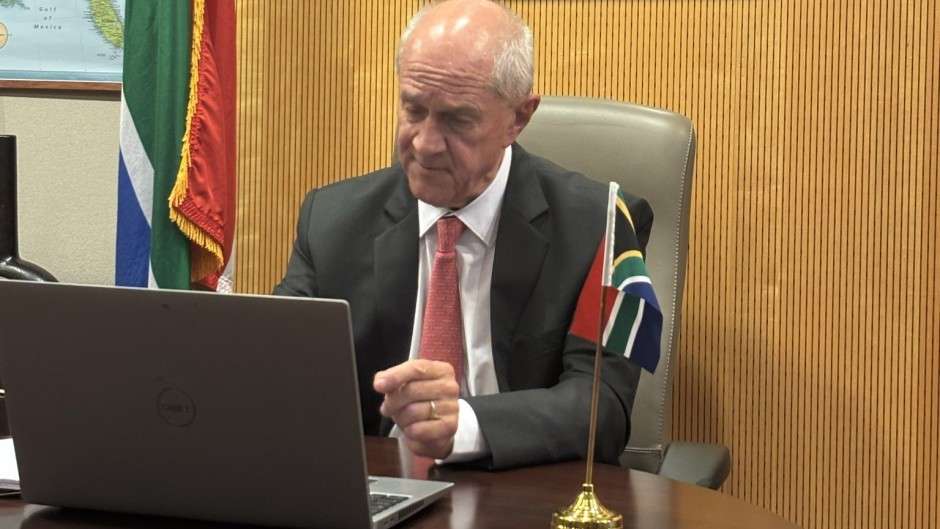
Meyer, 78, was received alongside 12 other diplomats and described the welcome as warm. He replaces Ebrahim Rasool, who was declared persona non grata by Washington in March 2025 after remarks critical of the Trump administration. The expulsion deepened an already fractured relationship, with the US pressing unsubstantiated claims about the persecution of white South Africans. encaenca
The diplomatic rupture had been building for over a year. South Africa was left without any recognised representation in Washington from 14 March 2025, when Secretary of State Marco Rubio declared the former ambassador unwelcome. That followed the notorious White House encounter in May 2025, which the Financial Times described as an ambush
when President Cyril Ramaphosa found himself confronted on camera with unverified genocide claims rather than welcomed as a partner. Ramaphosa’s domestic pressures have since intensified: as Afrikeye reported, he has turned to the courts to block his own impeachment over the Phala Phala scandal, a crisis that has further complicated his room for manoeuvre on the international stage.
Rebuilding Ties: Why Roelf Meyer is Pretoria’s Strategic Choice for Washington
Meyer’s appointment is a deliberate act of political signalling. He is the architect of South Africa’s negotiated transition — the man who sat across from the ANC in the early 1990s to forge the constitutional settlement that ended apartheid. His identity, as Atlantic Council non-resident senior fellow Colin Coleman wrote in the Daily Maverick, is inseparable from the craft of compromise. As Coleman noted, Meyer “of all people, understands the need to find balanced solutions among parties that profoundly disagree with each other, even when doing so resulted in him being accused of betrayal.” Pretoria is sending Washington a man whose biography is the argument. dailymaverick
The stakes are material, not ceremonial. South Africa’s GDP sits at under half a trillion dollars. The US economy stands at $32-trillion, commands the world’s most powerful military, and is home to the leading technology, research, and financial institutions on the planet. For South Africa — trapped in nearly two decades of low growth and unemployment that has climbed above 32 percent — access to American capital markets and investment flows is not optional diplomacy. It is structural necessity.
Of the top 100 largest publicly listed companies in the world, more than 60 are American, controlling roughly 75 percent of the total market value of the global top 100. Any serious strategy to attract the investment Ramaphosa has repeatedly promised requires engagement with those institutions, their Washington lobbyists, and the political power brokers on Capitol Hill. For the latest on South African business and economic developments, Afrikeye provides continuous coverage.
Coleman, a former Goldman Sachs CEO for sub-Saharan Africa, met privately with both Ambassador Meyer and US Ambassador to South Africa L. Brent Bozell III within days of each other in the lead-up to the credential presentation. He found Bozell to be an unambiguous Trump loyalist who nonetheless wants to stabilise the relationship and is prepared to seek constructive solutions — but will expect genuine movement from Pretoria on issues his principals care about.

The contested terrain is well-mapped. Land reform, Black Economic Empowerment regulations, South Africa’s positions on Gaza and Ukraine, its ties with Iran, its BRICS membership, and the suspension of AGOA preferences have all served as friction points. Washington has also frozen USAID disbursements to South Africa. None of these will be resolved by a credential ceremony. The region’s broader geopolitical fault lines are also in play: as Afrikeye reported, tension over the Strait of Hormuz is reshaping global trade flows in ways that directly affect South African export strategy and shipping costs. But the channel, closed for over a year, is now formally open.
Coleman has proposed two structured bilateral commissions as the most productive path forward — one focused on the economy, the other on security. For the economic track, he invokes the Gore-Mbeki bi-national commission of 1994, whose core mandate was business development, trade, investment facilitation, and connecting American companies to the post-apartheid economy. The parallel is pointed: South Africa is again at a hinge moment, and the same logic — draw American capital in through structured engagement — applies. The AfCFTA framework makes this even more consequential; what South Africa negotiates bilaterally with Washington has downstream effects for the continental free trade project that 54 African nations are building.
On security, the proposal draws on US partnership models with Brazil, Mexico, and Central American nations. A US-South Africa security partnership, Coleman argues, could begin with technology sharing, grow into intelligence cooperation, and ultimately target the organised crime networks steadily crowding out legitimate economic activity. The findings of the Madlanga Commission into the state of the South African Police Service have already exposed institutional dysfunction at the heart of law enforcement — and made the case for external expertise more difficult to dismiss.
Elsewhere on the continent, South Africa’s diplomatic standing matters for regional stability: the Ghana government’s decision to begin evacuating its citizens from South Africa amid xenophobic tensions is a reminder that Pretoria’s international credibility rests not just on its foreign policy posture, but on its domestic governance record.
The continental dimension is unavoidable. South Africa’s ability to anchor inward investment into the SADC region, and to serve as a gateway for African continental trade under AfCFTA, depends on the credibility of its external relationships. A South Africa isolated from Washington is a weakened broker for the continent. When Africa’s largest economy cannot speak to the world’s largest, the knock-on effects travel — through supply chains, through critical minerals negotiations, through the investment calculus of multinationals weighing sub-Saharan entry points. For a deeper look at how technology and digital infrastructure are reshaping Africa’s economic competitiveness in this new environment, Afrikeye’s tech desk tracks the key developments.
Coleman frames the challenge directly: “Nations operate on interests, not sentiment.” South Africa cannot afford reflexive anti-Americanism. Equally, Washington cannot build durable African partnerships while publicly misrepresenting what happens on the continent.
Meyer’s first task is to make both of those truths felt simultaneously. His record suggests he is capable of it. Whether the two governments can move from restored channels to substantive cooperation — on minerals, trade access, investment facilitation, and crime — will be the real test. The eNCA confirmed Meyer’s warm reception in Washington, while analysts at the South African Institute of International Affairs will be closely watching whether symbolic restoration translates into concrete policy shifts. The credential presentation was the beginning of a conversation, not its conclusion. What comes next — and how fast — will define whether this appointment becomes a footnote or a turning point. For ongoing African political analysis and opinion, stay with Afrikeye.