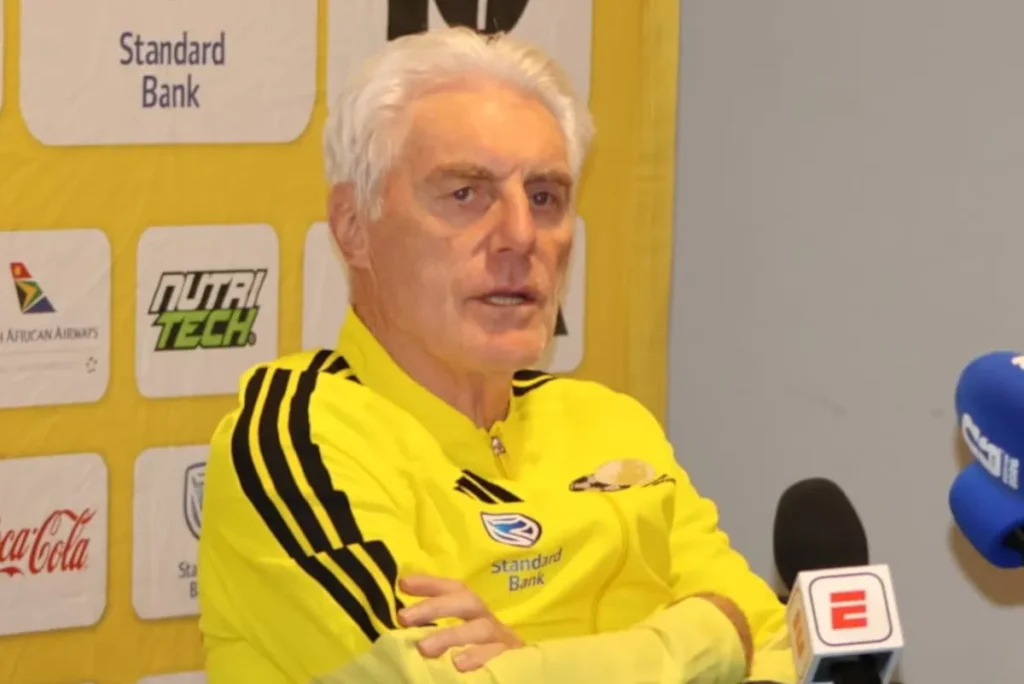
The historic journey of South Africa’s national football team at the 2026 FIFA World Cup has brought immense excitement alongside deep institutional questions about the future technical direction of the squad. With veteran manager Hugo Broos openly confirming that this global showpiece represents his final professional engagement before total retirement, the South African Football Association faces an immediate succession challenge. Consequently, football stakeholders and local analysts have launched intense public debates regarding the ultimate shortlist of bafana bafana coach candidates to lead the next generation.
The Belgian tactician has engineered a remarkable sporting revival over the past few years, transforming an underperforming group into a disciplined, highly competitive team that secured third place at the recent Africa Cup of Nations. As the squad navigates its challenging group stage fixtures in North America, fans are highly aware that Hugo Broos on verge of making history is also preparing to say his final goodbyes to international football. His departure will mark the conclusion of a highly successful era, leaving behind a profound legacy that the incoming management must respect and build upon.
Managing the transition smoothly is vital to prevent the national team from falling back into the cyclical instability that crippled previous developmental cycles. The decision-making process involving the executive committee will undoubtedly influence the sporting landscape and interact with national sports politics regarding resource allocation and indigenous talent development. Because of these high structural stakes, soccer administrators are carefully vetting the primary bafana bafana coach candidates to guarantee that the hard-won international momentum is not squandered.
The unique demands of the South African football environment mean that any incoming coach must possess a deep understanding of local player psychology and domestic league dynamics. The domestic Premier Soccer League remains one of the most affluent and competitive competitions on the continent, acting as the primary engine for national team call-ups. Consequently, managing this complex corporate structure requires a tactician who can comfortably balance athletic excellence with the commercial interests of the domestic football business environment.
This local familiarity has naturally narrowed the field of potential successors to a select group of experienced coaches who have proven their worth on African soil. Broad media networks have already identified a clear shortlist, publicizing the primary three candidates to replace Hugo Broos as part of an advanced post-World Cup strategy. Among these frontrunners, current assistant coach Helman Mkhalele is highly regarded by traditional legends because his direct involvement under Broos offers complete tactical continuity.
Another heavy favorite dominating public discourse is Benni McCarthy, whose unparalleled international playing pedigree and high-profile coaching background make him an extremely attractive option. McCarthy’s recent technical experience with major global clubs has proven his ability to handle elite locker rooms and manage high-pressure sporting environments. Appointing a manager of his stature would signal a bold new era for the national team, creating highly competitive jobs and developmental roles within the broader national technical training matrix.
Analyzing the Top Bafana Bafana Coach Candidates for Succession
Simultaneously, the domestic coaching tier has produced ambitious local leaders who are openly declaring their readiness to embrace the immense pressures of the national seat. Prominent tactician Eric Tinkler has publicly expressed his career aspirations, confirming that Eric Tinkler dreaming of the job remains a primary objective after years of consistent success in the domestic top flight. His impressive managerial track record with top-tier clubs like Cape Town City and Orlando Pirates solidifies his standing among the elite bafana bafana coach candidates capable of handling heavy institutional scrutiny.
Beyond personal ambitions, the next head coach will need to navigate a fast-evolving modern sports landscape that relies heavily on advanced technological integration. National football associations globally are abandoning legacy intuitive coaching models in favor of rigorous, data-driven analytical frameworks to optimize on-field performance. The incoming manager must be fully prepared to use specialized tracking software and digital video tech systems to dissect opponent strategies and analyze player movement patterns during intense qualification campaigns.
This digital transformation is reshaping how modern teams scout talent and manage physical workloads across extended international tournament schedules. The South African Football Association intends to look for advanced competencies when interviewing the final bafana bafana coach candidates, favoring individuals who can synthesize complex statistics. Incorporating automated performance metrics and predictive ai software allows technical departments to monitor player fatigue levels and minimize soft-tissue injury risks ahead of crucial matches.
The immense public scrutiny surrounding this selection process shows how deeply connected the national team remains to the collective pride of the country. Local sports commentators and retired legends are actively publishing their analytical opinion columns to influence the board’s final executive choices. They argue that the selected leader must possess absolute psychological resilience to withstand the aggressive media cycles that consistently follow the bafana bafana coach candidates during international campaigns.
Furthermore, the chosen technical team must prioritize comprehensive medical protocols to safeguard the long-term physical well-being of the international squad. Modern tournament formats demand optimal nutritional strategies, rapid recovery cycles, and strict monitoring of player health variables across different altitude zones. A modern coach must collaborate seamlessly with sports scientists and medical professionals to keep the core playing group operating at peak physiological capacity throughout the season.
While the current squad remains completely locked into their immediate World Cup fixtures in North America, the administrative wheels of succession must keep turning behind the scenes. SAFA must execute a transparent, merit-based selection process to ensure that the transition between Broos and his successor is entirely seamless. By carefully reviewing the tactical philosophies and leadership qualities of the available bafana bafana coach candidates, administrators can protect the future of South African football for generations to come.