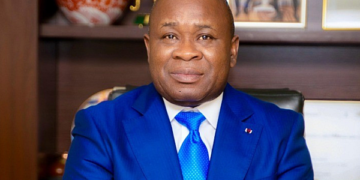





The structural evolution of national oil companies across the continent is taking center stage as African Energy Week (AEW) 2026 prepares to honor one of Central Africa’s most enduring energy executives. Maixent Raoul Ominga, the Director General of the Société Nationale des Pétroles du Congo (SNPC), has been officially named the recipient of the Lifetime Achievement Award for the upcoming October summit in Cape Town. The distinction marks a crucial moment for Africa’s economic landscape, highlighting how steady, institutional longevity can reshape state-backed resource enterprises into highly competitive corporate entities.
The Lifetime Achievement Award serves as the highest non-voting accolade at the annual African Energy Awards, recognizing leaders whose decades-long tenures have structurally advanced regional energy sovereignty and institutional transparency. Ominga’s trajectory within Congo’s state oil firm embodies this model; having initially joined the finance and accounting department in 2001, he scaled the corporate ladder to secure the Director General position in 2018. Subsequent reappointments in 2022 and 2025 demonstrate a sustained regulatory and political consensus regarding his fiscally disciplined management style.
The Leadership Strategy of Maixent Raoul Ominga in the Congo Energy Sector
Under Ominga’s stewardship, the Société Nationale des Pétroles du Congo has aggressively diversified away from purely extracting crude toward comprehensive resource monetization. A primary example of this strategic pivot is the company’s central role in the Congo LNG project. By building out the infrastructure required for liquefied natural gas production, the Republic of Congo is rapidly transitioning from a traditional drilling economy into an emerging global gas exporter. This development directly mirrors patterns across Sub-Saharan Africa where state operators are scaling up natural gas processing to meet both European market demands and domestic power generation requirements.
Equally significant has been a calculated effort to transition away from over-reliance on international lenders. By steering the national oil company toward regional and domestic capital markets, the administration has successfully cultivated localized financial mechanisms. This fiscal independence bolsters domestic banking networks while insulating critical national infrastructure projects from volatile international credit cycles. According to energy analyses frequently featured in major regional publications like African Business, establishing such robust internal capital structures is an essential prerequisite for any developing nation aiming to maintain true resource sovereignty.
Furthermore, these corporate adjustments are yielding social dividends within Congo’s broader business environment. The restructuring has prioritized local talent incubation, workforce diversification, and targeted gender inclusion within top-tier operational leadership. For international investors planning to converge at the upcoming African Energy Week, this multi-layered framework—combining financial independence with strict corporate governance—proves that African national oil companies can successfully evolve into highly transparent, modern energy players capable of steering long-term macroeconomic development.