




The End of Plastic: Why Your Physical Bank Card is Becoming Obsolete
In a rapidly evolving financial landscape, the traditional plastic bank card is quickly losing its status as a necessity in our daily lives. As we move further into 2026, the global shift toward digital-first banking has accelerated, with millions of consumers opting for mobile wallets over physical leather accessories. For our audience in the USA, this transition represents a massive leap in convenience and security, as the familiar bank card begins to be replaced by smartphones and wearable technology. This trend is a cornerstone of our latest Africa News Update 2026, highlighting a global move toward frictionless finance.
Recent data suggests that the move away from the physical bank card is reaching a tipping point. Whether it is the integration of biometrics or the expansion of “Tap-to-Phone” capabilities for small businesses, the infrastructure of the future is being built without the need for physical chips or magnetic strips. Today, we explore how this shift impacts retail, security, and the global economy.
Digital Wallets vs. The Traditional Bank Card: The 2026 Shift
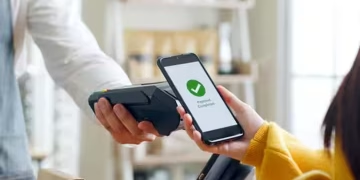
The competition between mobile payment apps and physical cards is no longer a contest. Platforms like Apple Pay, Google Wallet, and Samsung Pay have integrated deeply into the Business ecosystem, offering a level of speed that a traditional bank card simply cannot match.
The Rise of “Tap-and-Go” and NFC Technology
Near Field Communication (NFC) has become the standard for modern transactions. In 2026, most new smartphones are equipped with high-security NFC chips that allow for “tokenized” payments. Unlike a traditional card that broadcasts your actual account number, a digital wallet sends a one-time code, making it significantly harder for criminals to clone your credentials.
Africa News Update 2026: South Africa Leads the Charge in Cardless Banking
While many believe the USA is the leader in fintech, this Africa News Update 2026 reveals that South Africa is actually at the forefront of the “cardless” revolution. Major financial institutions in the region are actively encouraging customers to say goodbye to physical bank cards in favor of virtual alternatives.
Why Major Banks are Phasing Out Physical Issuance
- Cost Reduction: Printing and shipping plastic is an expensive logistical hurdle.
- Environmental Impact: Millions of expired cards end up in landfills each year; virtual cards solve this instantly.
- Instant Activation: A customer can open a Tech-based bank account and have a functional virtual card in seconds, rather than waiting days for mail delivery.
Retail Revolution: How Contactless Payments are Reshaping Global Commerce
The retail experience is undergoing a fundamental transformation. Merchants are no longer asking for a bank card; they are presenting QR codes or NFC-enabled tablets. Research shows that digital wallets are reshaping retail in Africa and beyond by reducing queue times and enabling loyalty programs to be automatically applied at the point of sale.
Security Benefits of Tokenization Over Magnetic Strips
Magnetic strips are 1970s technology. They are easily skimmed and duplicated. By shifting away from the physical card, we eliminate the risk of “shoulder surfing” or card-cloning devices at ATMs. This has positive implications for the Health of our financial systems, reducing the stress associated with identity theft and fraud recovery.
As global trends shift, even the sports world is adapting. See our recent post on who won the Masters 2026 to see how digital-first ticketing is changing fan experiences.
Conclusion: Adapting to a Wallet-Free Future
The slow death of the physical bank card is not a sign of a struggling economy, but rather a sign of a maturing one. As highlighted in this Africa News Update 2026, the move toward virtual finance offers better security, lower costs, and a more streamlined user experience. Whether you are using your phone to pay for a coffee in New York or using a QR code at a market in Johannesburg, the future of money is undeniably digital.
Stay updated on the latest AI trends in finance and explore our Sports section for news on how stadiums are going 100% cashless this season.