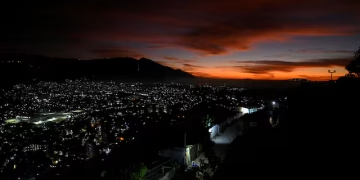





CARACAS, Venezuela – The world is reeling following a series of high-stakes military maneuvers by the United States on Venezuelan soil. In the early hours of Saturday, January 3, 2026, President Donald Trump announced that Maduro has been captured and removed from the country following a “large-scale strike.”
Global Outcry as US Forces Capture Maduro in Massive Strike
The operation, which reportedly involved the elite Delta Force, targeted several strategic locations, including the Fuerte Tiuna military complex and the La Carlota air base. As smoke rose over the capital, the international community scrambled to respond to what many are calling a turning point in global diplomacy.
World Leaders Condemn “Armed Aggression”
The reaction from global capitals has been swift and largely critical. The Russian Foreign Ministry described the event as an “act of armed aggression,” expressing deep concern over the violation of Venezuelan sovereignty. Moscow emphasized that Maduro and the Venezuelan people must be allowed to determine their own destiny without external military interference.
Similarly, Iran’s Supreme Leader Ayatollah Ali Khamenei vowed resistance against what he termed “arrogant” imposition. In a statement, Tehran warned that such actions threaten the stability of the entire international system. These developments are being watched closely across the Atlantic and in Africa, where regional stability and the principles of non-interference remain paramount in continental politics.
Constitutional Uncertainty in Caracas
With the reported capture of the president, the future of the Venezuelan government hangs in a delicate balance. Vice President Delcy Rodríguez has demanded “proof of life” for Maduro and First Lady Cilia Flores, stating that their whereabouts remain unknown to the regime.
Under Article 233 of the Venezuelan Constitution, the “absolute absence” of a president should trigger a transition of power to the Vice President, followed by elections within 30 days. However, with the opposition—led by figures like Edmundo González and María Corina Machado—viewing this as a moment for a “peaceful transition,” the path forward is anything but certain.
Precision Strikes and Special Operations
Military analysts suggest the raid on maduro was executed with “impressive speed.” Reports indicate that a robust air package, including over a dozen helicopters and specialist aircraft, supported the ground teams. While the Venezuelan Defense Ministry vowed to resist the “invasion,” reports from the ground suggest that corruption and poor maintenance may have hampered the local response.
US Secretary of State Marco Rubio reportedly indicated that Maduro was taken into custody to stand trial on long-standing criminal charges in the United States. This follows a 2020 indictment for narco-terrorism, for which the US government had placed a $50 million bounty on his head.
Regional Neighbors Distance Themselves
As the dust settles, neighboring nations are clarifying their positions. Trinidad and Tobago issued a formal statement confirming they did not participate in the military operations. Despite recent security cooperation with Washington, the Caribbean nation emphasized its continued peaceful relations with the people of Venezuela.
Spain and Italy have also called for de-escalation, urging all parties to adhere to the principles of the UN Charter. As the world waits for the 11 A.M. press conference at Mar-a-Lago, the capture of Maduro remains the most significant US military intervention in the region in decades.
Impact on International Diplomacy
Spain and Italy have also called for de-escalation, urging all parties to adhere to the principles of the UN Charter. The capture marks a dramatic shift in US foreign policy under the “Trump Corollary” to the Monroe Doctrine, asserting the use of lethal force over traditional law enforcement strategies.
As the world waits for the 11 A.M. press conference at Mar-a-Lago, the capture of Maduro remains a startling development. It mirrors historical events such as the 1989 invasion of Panama and the capture of Manuel Noriega, signaling a return to a more aggressive US stance in its “backyard.”