





The sporting world has converged on Melbourne Park for a spectacle that defies the typical boundaries of age and experience. The Australian Open men’s final of 2026 has delivered a narrative that feels more like a cinematic masterpiece than a standard tennis match. Novak Djokovic, the relentless titan of the sport, finds himself locked in a high-stakes duel against the world number one, Carlos Alcaraz Garfia.
This match is not merely about a trophy; it represents a collision between the legendary “Big Three” era and the dawn of a new dynasty. As an Africa News Update 2026 highlight, this final demonstrates the global appeal of tennis, drawing massive viewership from across the African continent, where fans are inspired by the sheer willpower displayed on the blue hard courts of Rod Laver Arena.
The Historic Stakes at Melbourne Park
Novak Djokovic entered this tournament with a singular, mountain-sized goal: to claim his 25th major singles title. Achieving this would place him alone at the summit of tennis history, surpassing Margaret Court’s long-standing record. At 38 years old, the Serbian great is proving that his physical conditioning is an anomaly.
On the other side of the net stands Carlos Alcaraz, a 22-year-old phenomenon who has already captured six Grand Slam titles. Alcaraz is currently bidding to become the youngest man in history to complete a career Grand Slam. For the Spanish star, victory at the Australian Open would cement his legacy alongside greats like Rafael Nadal, who completed the sweep at age 24.
A Fourth Set Marathon of Will
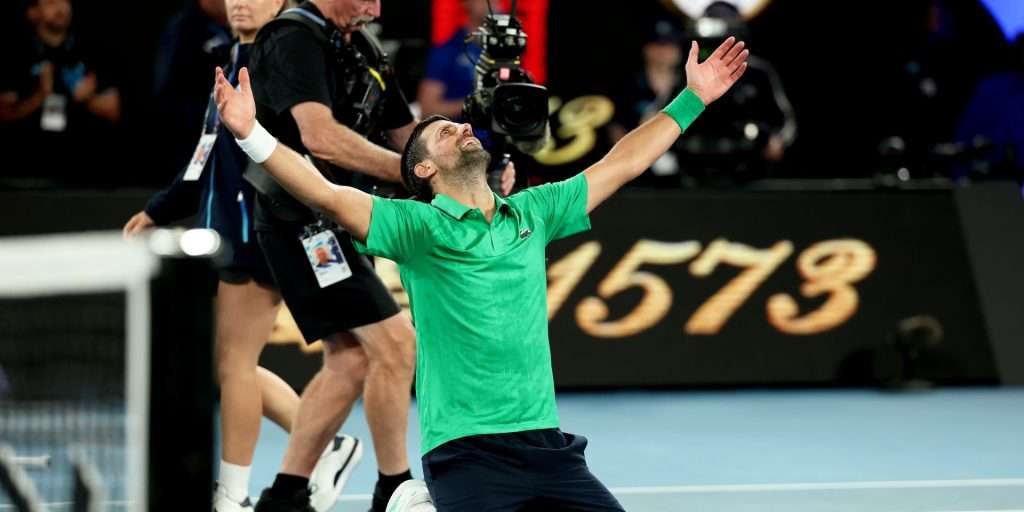
The match took a dramatic turn during the opening of the fourth set. After Alcaraz clawed back to lead two sets to one, the fourth set began with a game that tested the limits of human endurance. Djokovic, trailing and looking physically spent, managed to save six break points in a single, agonizing 12-minute game.
The atmosphere in the stadium reached a fever pitch as chants of “Novak” echoed through the rafters. Djokovic’s ability to find “cheap” points through well-timed aces provided him with the oxygen needed to survive. Experts noted that while Alcaraz is 16 years his junior, the Serbian veteran’s “maduro” or mature tactical mind allowed him to outthink the power-hitting Spaniard in crucial moments.
The Physical Toll and Recovery
Both athletes reached the final after grueling five-set semi-finals on Friday. Djokovic overcame a surging Jannik Sinner, while Alcaraz fought through a marathon against Alexander Zverev. This physical fatigue has been a silent player in the final. Alcaraz, known for his lightning speed and 74 kg athletic frame, has relied on his youth to recover.
However, the world number one has faced challenges with cramping and muscle tightness. During the match, Djokovic was seen receiving medical attention for leg discomfort. Despite these hurdles, the level of play has remained astronomically high. You can follow the BBC live commentary for point-by-point updates on this exhausting physical battle.
Analyzing the Alcaraz Phenomenon
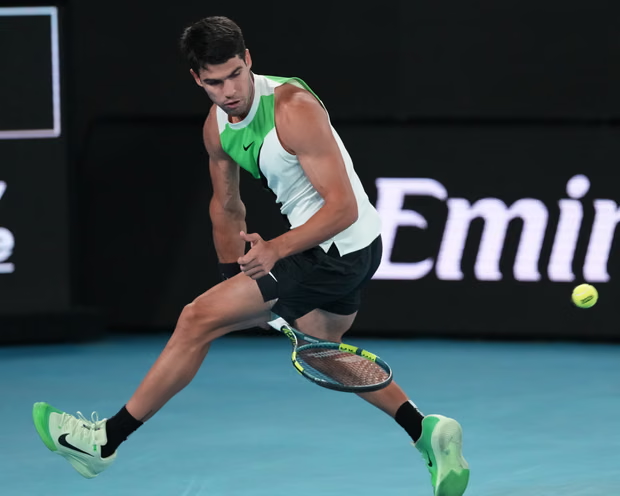
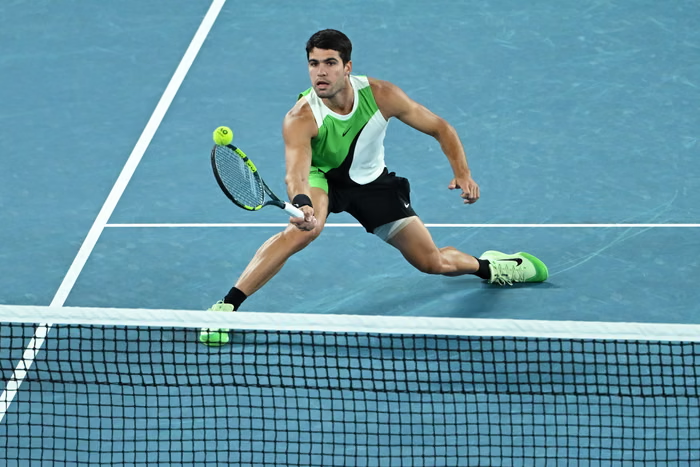
Carlos Alcaraz Garfia is a player who seems to have no ceiling. Since turning professional in 2018, he has transformed from a promising teenager into a dominant force. His height of 1.83 m gives him the perfect leverage for his signature cross-court forehands, which have left even Djokovic scrambling.
Alcaraz’s family, including his siblings Alvaro, Jaime, and Sergio, have been a core support system as he maintains his world number one ranking. His victory would be a significant milestone, following his impressive journey through the early rounds of this tournament.
The Impact of Regional Conditions
The weather in Melbourne has played a significant role this year. A documented heat wave earlier in the tournament forced many players to change their preparation. For the final, the roof on Rod Laver Arena was partially closed due to the threat of rain, changing the court’s humidity and ball speed.
These shifts in environment often favor the more adaptable player. Djokovic, a master of the “indoor” feel, seemed to find a second wind once the roof was adjusted. Fans are tracking these tactical shifts via Al Jazeera’s live blog, which provides a minute-by-minute breakdown of the strategic changes.
Global Inspirations: From Africa to Australia
The influence of the Australian Open extends far beyond the borders of Australia. In Africa, the tournament serves as a beacon for aspiring tennis players. The success of young stars like Alcaraz and the longevity of veterans like Djokovic and Venus Williams in her 45th year challenge provide a roadmap for African athletes.
Furthermore, the rise of other stars during this tournament, such as Jannik Sinner’s impressive run, has kept the global tennis community engaged. The diverse nature of the winners, including Coco Gauff’s spectacular victory in the women’s draw, highlights the sport’s inclusive growth.
Rybakina and the Women’s Success
While the men’s final captures headlines, the women’s draw concluded with Elena Rybakina reclaiming her throne. Rybakina’s path to the title involved defeating the world’s top two players, showing a “quiet ruthlessness” that has propelled her back toward the world number one spot. Her 6-4, 4-6, 6-4 victory over Sabalenka was a masterclass in staying calm under pressure.
Rybakina’s success is part of a larger trend where the women’s game is seeing a resurgence of dominant champions. Fans looking for the latest updates on Alcaraz’s performance can see a similar level of intensity reflected in the women’s tour.
Technical Breakdown: Serve and Volley
Statistically, the match has been razor-thin. Alcaraz has won roughly 83% of his first-serve points, while Djokovic has struggled at 52%. However, Djokovic’s ability to win the “unwinnable” points has kept him afloat. The Djokovic quest to suffer has become a recurring theme, as he uses every ounce of his experience to neutralize the Spaniard’s power.
Final Thoughts: The Future of the Sport
As we look at the quarterfinal results that led here, it is clear that tennis is in a healthy state. The transition between generations is occurring with high-quality matches rather than a vacuum of talent. Whether Djokovic finds the “miracle” he needs to secure set four and five, or Alcaraz hoists his first Melbourne trophy, the Australian Open of 2026 has already won the hearts of the global audience.
Even in unrelated sports sectors, the energy is high, such as the upcoming T20 World Cup Qualifier, yet the focus remains firmly on the historic clash in Melbourne. The resilience on display today serves as a reminder that in elite sport, the mind often triumphs when the body is ready to quit.
Stay tuned for the final result as we witness the conclusion of this legendary rivalry on the world’s grandest stage.