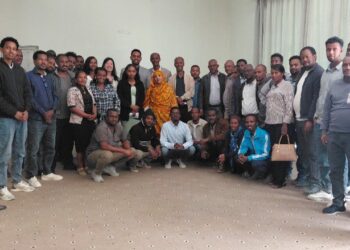





Civil service members of the People’s Front for Democracy and Justice (PFDJ) in Eritrea’s Berik sub-zone have mobilized a massive communal environmental drive. Running actively since January 2026 across 12 distinct administrative areas and 21 villages, the grassroots movement accelerates sustainable agriculture in Eritrea by combating land degradation and safeguarding localized water tables. Executed in direct alignment with the strategic guidelines of the Ministry of Agriculture, the community-led operation works to protect vulnerable arable land ahead of the upcoming seasonal downpours.
The extensive agro-ecological campaign relies heavily on the structured participation of civil servants and local farming communities to build structural climate resilience. According to Ms. Rahwa Qeleta, the sub-zone’s PFDJ secretary, field teams are currently preparing thousands of specialized planting pits to house 4,000 tree seedlings across five hectares of targeted public land. This intense afforestation effort alters the local politics of ecological planning, showing how decentralized, state-backed civic groups can execute major restoration goals without relying on foreign intervention pools.
Building Stone Terraces to Support Sustainable Agriculture in Eritrea
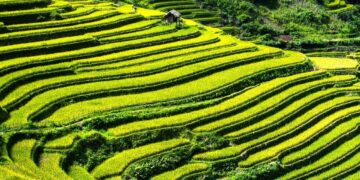
A primary structural milestone accomplished during the initial phases of the drive is the extensive construction of stone and soil terraces over 1,200 hectares of degraded hillside slopes. Mr. Major Mengisteab, head of the sub-zone’s agriculture branch, explained that these earthworks are essential to slowing down heavy rainwater runoff and keeping precious nutrients within the topsoil layer. By stopping topsoil erosion, the terraces establish a stable foundation for the upcoming rainy season, during which municipal offices plan to plant more than 350,000 fresh tree seedlings.
| Conservation Activity Executed | Measured Field Progress (Mid-2026) | Upcoming Seasonal Projections |
|---|---|---|
| Hillside Terrace Construction | Completed across 1,200 hectares of land | Expansion to adjacent grazing perimeters |
| Pitting for Targeted Seedlings | Prepared holes for 4,000 trees on 5 hectares | Scaled up to absorb 350,000 upcoming plantings |
| Spatial Operational Outreach | Deployed across 12 sectors and 21 villages | Continuous community maintenance loops |
| Primary Execution Body | Civil service workers and PFDJ members | Expanded mobilization of local student squads |
The successful setup of these large-scale terracing networks is heavily modifying the regional business landscape by securing future agricultural output for rural markets. When hillside topsoil washes away during heavy rains, local smallholder crop yields drop significantly, driving up food prices in urban centers. By stabilizing the primary soil structure, the campaign assures independent farming cooperatives of predictable harvests, expanding rural trade networks and lowering financial operating costs across regional food markets.
The long-term management of these massive terracing networks is creating thousands of stable public sector jobs and monitoring roles for agricultural extension officers, conservation technicians, and seedling nursery operators across the country. Local residents have expressed absolute readiness to expand their volunteer shifts, transforming simple environmental relief into a national movement for economic self-reliance. This community-centered focus ensures that public investments directly fight rural poverty while keeping specialized environmental talent working within local borders.
To trace soil moisture indexes and map seedling survival percentages across remote mountain villages, central planners are introducing advanced mapping tools within the growing national tech sector. These digital registries allow field inspectors to log terrace dimensions, monitor nursery stock levels, and share ecological data instantly with central offices. This digital transparency removes processing bottlenecks, matching the modern, data-driven tracking frameworks managed by the Africa CDC emergency registry to handle cross-border administrative hurdles.
Independent environmental analysts sharing their professional opinion columns emphasize that arid East African economies must prioritize natural resource preservation to defend long-term food security lines. They argue that pairing indigenous terracing techniques with structured civil workforce movements protects basic public health metrics by safeguarding clean drinking water supplies. Incorporating advanced predictive data models and specialized ai resource distribution tracking ensures that public tool supplies reach remote volunteer squads exactly when field pressures peak, cementing a sustainable blueprint for continental land recovery.