




Groundbreaking continental data reveals that widespread public advocacy for women’s autonomy is rapidly reshaping the social and legal landscape across diverse developing nations. The latest Afrobarometer Pan-Africa Profile highlights a powerful, historic public endorsement for female independence in both domestic and professional environments. However, this progressive cultural evolution faces severe resistance from weak institutional enforcement structures that continue to leave vulnerable citizens exposed to systemic discrimination.
The comprehensive survey, which compiled 50,961 face-to-face interviews across 38 African nations during the recent research cycle, highlights a broad consensus favoring women’s autonomy in marriage and reproductive choices. An impressive 75 percent average majority explicitly supports a woman’s right to independently choose her spouse, while 62 percent endorse full reproductive freedom regarding the timing and number of children. This profound baseline shift indicates that grassroots populations are actively outgrowing archaic traditional frameworks that historically restricted personal self-determination.
Despite these encouraging social milestones, the path toward full women’s autonomy is heavily restricted by stubborn macroeconomic inequalities and household disparities. While 57 percent of citizens endorse equal rights to professional employment, an alarming 38 percent still believe that men should receive priority access when competitive positions are scarce. This persistent bias directly compromises the expansion of regional jobs and prevents qualified female professionals from entering high-value corporate spaces. Furthermore, nearly one-quarter of respondents report that families or husbands actively block women from taking employment, while only 36 percent of women report holding primary household financial decision-making power compared to 44 percent of men.
These economic roadblocks heavily impact the landscape of local politics as civil rights groups demand stronger legal safeguards to protect female workers. Moving past outdated patriarchal labor assumptions is totally vital to diversify executive talent pools and revitalize the broader continental business environment. When institutional biases limit female workforce participation, national economies lose out on massive productivity gains, slowing down regional infrastructure development and long-term capital accumulation.
Dismantling Institutional Barriers Facing Women’s Autonomy
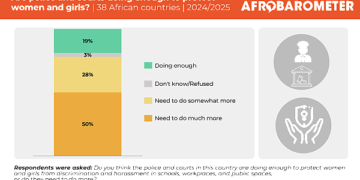
The extensive survey data also shines a harsh light on critical security vulnerabilities that continue to undermine the daily safety and dignity of women and girls. More than one-quarter of citizens report that schoolgirls frequently face intense discrimination, harassment, and transactional requests for sexual favors from teachers. A matching 28 percent state that women routinely experience aggressive sexual harassment in public spaces, such as open markets, urban streets, and public transportation networks. While 65 percent of respondents believe that victims are likely to be believed when reporting these abuses, an overwhelming 78 percent declare that the police and courts must do much more to enforce safety.
“Fostering genuine women’s autonomy requires an uncompromised commitment from state judiciaries to root out public harassment and protect civil liberties with absolute transparency.”
To manage these complex socio-economic challenges with high precision, public welfare departments are attempting to upgrade their data tracking networks. Administrative agencies are deploying decentralized reporting systems and secure digital registries within the continent’s expanding tech sector to monitor gender-based violations in real time. This automated infrastructure expansion allows local authorities to identify high-risk districts and deploy protective security resources exactly where they are needed most.
Furthermore, the mapping of public safety indicators and the analysis of societal risk trends are being accelerated through specialized computational architectures. Governance organizations are exploring how advanced predictive analytics and specialized ai data modeling can help streamline the tracking of legal complaints through local court dockets. Integrating this automated intelligence ensures that judicial systems can process discrimination cases efficiently, ensuring that perpetrators face swift legal consequences without creating administrative delays.
Independent sociological analysts sharing their professional opinion columns emphasize that legal reforms must run alongside massive improvements in rural utility access to achieve true equity. The Afrobarometer findings reveal a deep healthcare disparity, with two-thirds of women reporting that they or a family member went without necessary medicines or medical treatment at least once during the previous year. This severe medical deficit impacts rural women far more intensely than their urban counterparts, highlighting a critical flaw in current public health distribution networks.
Prioritizing the physical well-being of female citizens directly strengthens sub-regional community health profiles, proving that sustainable development requires a healthy workforce. Interested stakeholders, civil society leaders, and policy analysts can explore full data breakdowns by connecting directly with the official Afrobarometer research portal online. By combining rigorous face-to-face research with actionable policy insights, international tracking networks are helping African nations dismantle deep-seated biases and build an equitable, highly inclusive future.