




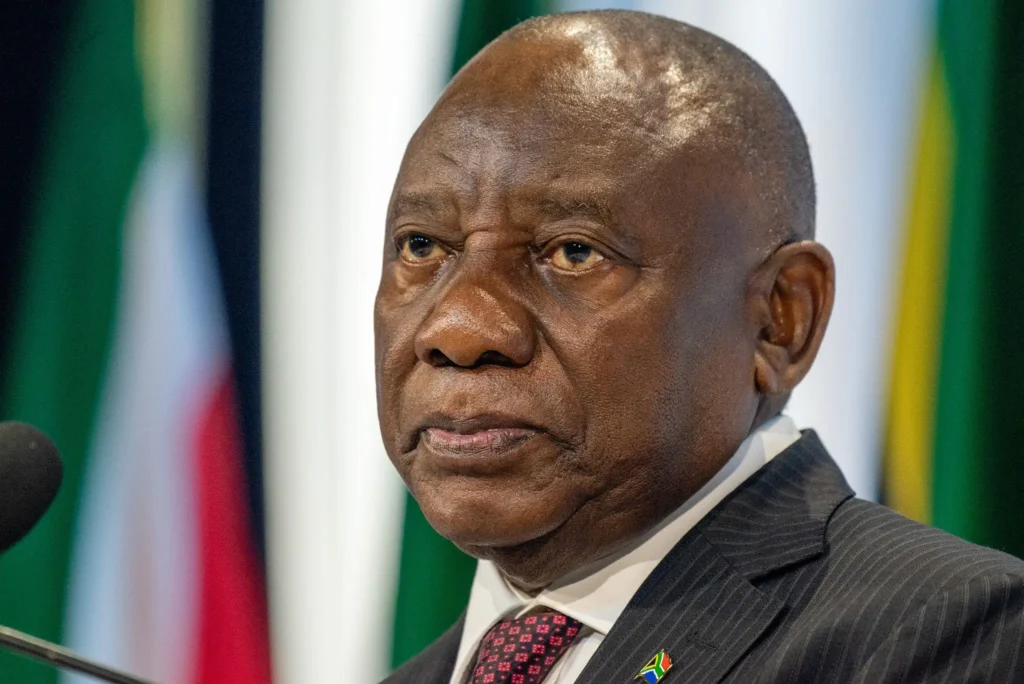
South Africa’s President Cyril Ramaphosa has asked the country’s most senior judge for permission to legally challenge the parliamentary panel that found he had a case to answer — a move that could freeze the impeachment process against him for years and set a dangerous precedent for executive accountability across the continent.
Ramaphosa wrote to Chief Justice Mandisa Maya seeking consent to serve legal papers on members of the Section 89 panel, which last year concluded there was prima facie evidence of serious misconduct linked to the theft of more than half a million US dollars from his Phala Phala game farm in 2020. The procedural step is required under the Superior Courts Act because the panel included a retired judge. His legal team intends to take the full report on judicial review, arguing it was flawed in both law and fact.
The Phala Phala scandal has shadowed Ramaphosa’s presidency since the theft — which he failed to report to police — was exposed in 2022. A panel chaired by former Chief Justice Sandile Ngcobo found he had questions to answer. The ruling African National Congress used its parliamentary majority to vote down the report in December 2022 and kill the impeachment inquiry. The Constitutional Court then ruled that vote irrational and invalid, compelling Parliament to reopen the process. Ramaphosa’s court application is, in effect, a second attempt to close it again.
The stakes for South Africa’s constitutional architecture are substantial. If Chief Justice Maya grants the application and the review proceeds, Parliament will be legally prevented from holding impeachment hearings while the matter works its way through the courts — a process that routinely takes months and can extend to years. Business Day has reported that this outcome would severely erode public confidence in the country’s accountability institutions, already strained after a decade of state capture under former President Jacob Zuma.
Ramaphosa’s legal representatives insist the review application is not a delay tactic but a matter of ensuring that findings of such gravity rest on a sound legal and factual foundation. Opposition parties are unconvinced. Leaders of the Economic Freedom Fighters and ActionSA condemned the move as a calculated effort to postpone accountability through procedural manoeuvring. Independent legal analysts have raised a separate concern: forcing another judge to re-examine the panel’s conclusions does not resolve the political crisis — it relocates it from Parliament to the judiciary.
The tactic fits a pattern visible across the continent. In Senegal and Kenya, incumbent leaders have used administrative and constitutional litigation to slow or obstruct legislative oversight, substituting courtroom delay for political accountability. What distinguishes South Africa — for now — is that the President must still seek a presiding judge’s consent before launching his defence, preserving at least a formal check on executive overreach. But that distinction narrows if the courts become a reliable instrument for indefinitely postponing parliamentary scrutiny.
The case also carries direct relevance for the African Union’s Agenda 2063, which commits member states to democratic governance and the rule of law as conditions for continental integration. A South Africa that demonstrates accountability institutions can be legally outmanoeuvred undermines the normative framework the AU has spent years building. Other governments watching Pretoria now have a detailed procedural blueprint for how to delay — without technically defying — a constitutional impeachment mechanism.
The African National Congress, which governs with a coalition partner after losing its parliamentary majority in last year’s elections, has not publicly stated whether it will support or resist the review application. Its silence is itself a political signal. The party’s capacity to shield the President through parliamentary arithmetic no longer exists as it once did, which may explain why the legal route has become the preferred line of defence.
Chief Justice Maya’s decision on whether to grant permission will determine the immediate path. If she refuses, Parliament must proceed to hearings without further delay. If she agrees, the case enters the court system, and the impeachment clock stops. The ruling is expected in the coming weeks. How South Africa’s most powerful judicial officer responds will reveal whether the country’s separation of powers can hold against a determined executive with skilled lawyers and time on his side.
The Phala Phala review application is no longer just about hidden foreign currency; it is a profound stress test for the separation of powers. A robust democracy requires leaders who submit to public accountability rather than hiding behind the robes of a judge to delay the inevitable. For comprehensive analysis on institutional transparency across the continent, explore the Afrikeye platform, or plan your next diplomatic conference travel via Afrikeye Travel.