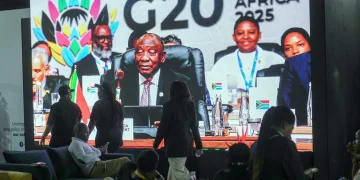





WEST PALM BEACH, Fla. — President Donald Trump announced Wednesday that South Africa will not be invited to participate in the 2026 G20 summit near Miami and that all U.S. payments and subsidies to the country will be immediately halted. This follows South Africa’s handling of a U.S. government representative at the recent Johannesburg summit, which Trump described as unsatisfactory.
Trump’s Claims and South Africa’s Response
Trump, who did not send a U.S. delegation to this year’s Johannesburg summit, cited alleged persecution of white Afrikaners in South Africa as the reason for his actions. The South African government has consistently rejected these claims, calling them misinformation.
In a post on Truth Social, Trump wrote:
“South Africa has demonstrated to the World they are not a country worthy of Membership anywhere, and we are going to stop all payments and subsidies to them, effective immediately.”
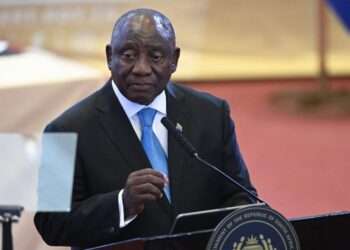
South African President Cyril Ramaphosa’s office responded that the U.S. decision to appoint a local embassy official for the G20 handover was considered an insult. The handover ceremony was conducted at the Foreign Ministry instead, as the U.S. had not attended the summit. Ramaphosa described Trump’s announcement as “regrettable” and criticized the punitive measures based on distorted information about the country.
Diplomatic Tensions and International Relations
The 2025 Johannesburg summit, the first G20 meeting hosted in Africa, was boycotted by the U.S. The summit’s declaration addressing climate change and developing-country issues went unsigned by Washington. Trump’s administration has repeatedly criticized South Africa’s international relations and its diplomatic ties with China, Russia, and Iran, framing the country as anti-American.
South Africa has firmly refuted claims regarding violence against Afrikaner farmers and land seizures, emphasizing that these allegations are widely discredited. Afrikaners, descended from European settlers, number approximately 2.7 million in a population of 62 million. While some were involved in apartheid, the group is diverse and not homogenous.
Implications for South Africa and Global Diplomacy
Trump’s actions, including restricting U.S. refugee admissions to 7,500 annually with most slots for white South Africans, highlight ongoing tensions in South Africa’s global diplomacy. The U.S. now holds the rotating G20 presidency, leaving the impact of South Africa’s recent diplomatic efforts uncertain.
Experts note that Trump’s approach underscores a personal and political dimension to international interactions, potentially affecting South Africa’s position in global forums and trade discussions.
South African officials are calling for solidarity among G20 members to defend the integrity of the summit and ensure all member states are treated fairly.
This episode represents a significant moment in South Africa’s international relations, raising questions about the role of U.S. unilateral actions in multilateral settings and their broader impact on diplomatic norms.
For more travel insights, visit Afrikeye Travel.
This story was first reported by AP News. Read the full article here.