





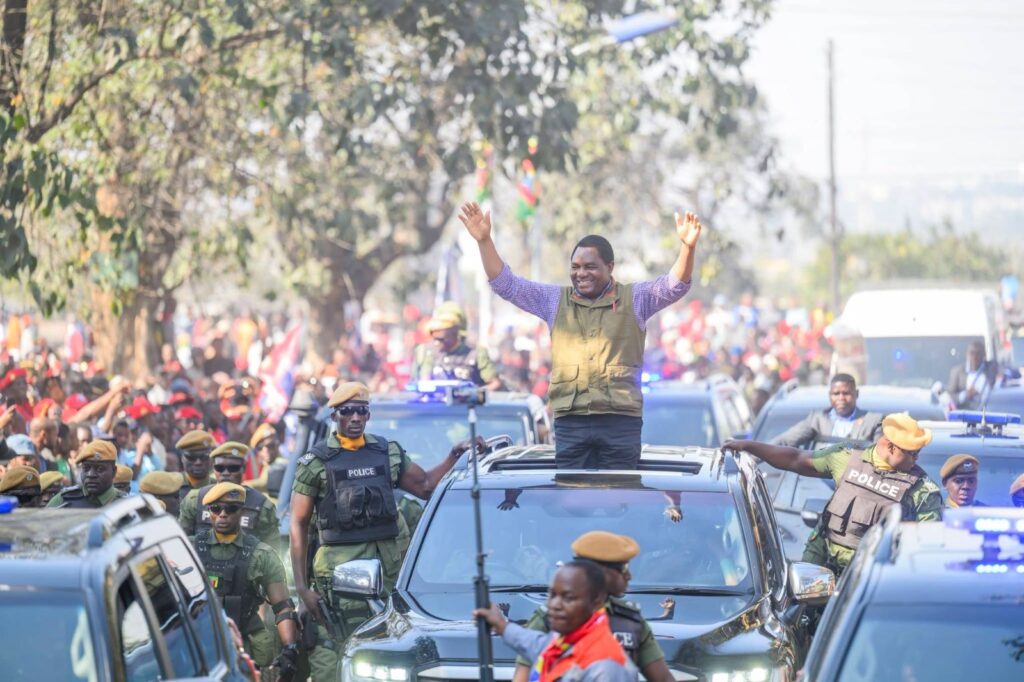
As Zambia’s election campaign gathers momentum ahead of the 13 August 2026 general election, the political landscape is increasingly coalescing around two principal contenders: the governing United Party for National Development (UPND), led by incumbent President Hakainde Hichilema, and the Tonse Alliance, led by Brian Mundubile.
While several presidential candidates remain on the ballot, the campaign has increasingly centred on these two political formations, each presenting a distinct vision for Zambia’s economic future. On one side is the UPND, asking voters to renew its mandate to continue the reforms it says have restored macroeconomic stability, strengthened investor confidence and laid the foundations for long-term growth. On the other is the Tonse Alliance, arguing that Zambia now needs a broader policy reset built around production, industrialisation, governance reform and accelerated economic transformation.
Beyond campaign rallies, political slogans and headline-grabbing exchanges, the manifestos provide a valuable opportunity to examine what each alliance is proposing for the country. Although they differ in emphasis and philosophy, both seek to address the same underlying challenges: creating jobs, reducing poverty, strengthening institutions, improving public services and positioning Zambia for sustainable economic growth.
At the heart of this election lies a fundamental question: Should Zambia continue along its current reform path, or is a broader policy reset needed to unlock the country’s productive potential and accelerate economic recovery?
Two Visions, One Destination
At first glance, the UPND and Tonse Alliance appear to offer competing economic philosophies.
The UPND asks voters to judge it on its record since taking office in 2021. Its manifesto argues that debt restructuring, fiscal discipline, macroeconomic stability and restoring investor confidence have created the conditions necessary for long-term growth. The next phase, it argues, is to consolidate those gains through continued investment, infrastructure development and job creation.
The Tonse Alliance, meanwhile, contends that while stability is important, it has not translated quickly enough into improved living standards for many Zambians. Its manifesto is anchored on what it calls the H.O.P.E. philosophy—Hard Work, Order, Production and Equity—and proposes a production-led economy focused on manufacturing, value addition, exports and stronger domestic industries.
Despite these contrasting narratives, the two manifestos share more common ground than political debate sometimes suggests.
Both identify mining, agriculture, manufacturing, tourism and technology as strategic sectors. Both promise to create jobs, improve healthcare and education, strengthen infrastructure, expand opportunities for young people and attract investment.
The difference lies not so much in what they hope to achieve, but in how they intend to achieve it.
Neither development model is new.
The UPND’s emphasis on macroeconomic stability, fiscal discipline and investor confidence reflects approaches that have underpinned long-term growth in countries such as Botswana, Mauritius, Rwanda and Vietnam. These economies maintained relatively predictable policies, strengthened public institutions and created environments where businesses could invest with confidence.
Botswana’s prudent management of mineral revenues, Mauritius’ economic diversification and Vietnam’s market-oriented reforms demonstrate how stable macroeconomic management can support sustained growth. Yet these countries also illustrate an important lesson: stability alone is not enough. Economic reforms must eventually produce better jobs, higher incomes and improved living standards if they are to retain public support.
The Tonse Alliance’s production-led strategy draws on another well-established development model.
South Korea transformed itself from one of the world’s poorest nations into a high-income industrial economy through export-led manufacturing, investment in education and deliberate industrial policy. China accelerated its rise by combining market reforms with strategic investment in manufacturing and infrastructure. Morocco has positioned itself as a regional automotive and aerospace manufacturing hub through targeted industrial policies, while Ethiopia’s period of rapid economic expansion was driven in part by industrial parks and infrastructure investment.
These experiences point to another important lesson: countries rarely achieve lasting prosperity by exporting raw materials alone. Long-term economic transformation generally requires adding value, expanding manufacturing and building competitive domestic industries.
The global evidence, however, also warns against viewing either model as a complete solution. Fiscal discipline without meaningful employment can leave many households feeling disconnected from economic progress. Equally, ambitious industrial policies require sound public finances, capable institutions and disciplined implementation if they are to remain sustainable.
For Zambia, the challenge may therefore be less about choosing between stability and production than about combining both.
Governance is another area where the manifestos diverge in emphasis.
The Tonse Alliance places judicial independence, electoral credibility, media freedom and institutional reform at the centre of its programme, arguing that stronger democratic institutions are essential for economic confidence.
The UPND also commits to strengthening governance and combating corruption but presents these initiatives as reforms already underway rather than a new agenda.
International experience reinforces the importance of institutions regardless of the economic strategy pursued. Countries with predictable regulations, effective public administration and strong rule-of-law frameworks tend to attract more long-term investment than those characterised by policy uncertainty.
Employment remains the defining issue.
The UPND has pledged to create two million jobs over the next five years, linking employment growth to private investment, mining expansion and economic diversification. The Tonse Alliance focuses on employment through industrial development, support for small and medium-sized enterprises and expanding productive sectors.
History suggests that durable employment growth usually occurs when macroeconomic stability is combined with expanding productive industries rather than relying on either approach alone.
Manifestos are statements of intent, not implementation plans.
Whether the commitments relate to infrastructure, healthcare, education, industrialisation or employment, success will ultimately depend on institutional capacity, sustainable financing and consistent execution.
International experience offers perhaps the clearest lesson of all: the countries that have transformed their economies have rarely chosen between macroeconomic stability and industrial development. Instead, they have combined prudent fiscal management with investment in productive sectors, strong institutions, quality infrastructure and long-term policy consistency.

What This Means for Zambia
As one of Africa’s largest copper producers and a key member of the Southern African Development Community (SADC), Zambia’s policy choices will shape not only its own economic future but also regional trade, investment and supply chains.
Regardless of who forms the next government, familiar challenges will remain: managing public debt, ensuring reliable electricity, diversifying the economy, creating quality employment and translating economic growth into higher living standards.
The evidence from around the world suggests that prosperity is seldom achieved through a single economic philosophy. It is built by combining stable macroeconomic management with productive investment, industrial expansion, capable institutions and consistent implementation over many years.
For Zambian voters, the most important question may therefore not be whether continuity or change offers the stronger campaign message, but which leadership team has the credibility, institutional capacity and discipline to turn ambitious promises into measurable results.
Disclaimer: This article is an independent policy analysis based on publicly available information, party manifestos and comparative international development experience. It is intended to encourage informed public discussion and should not be interpreted as an endorsement of any political party or candidate. The views and opinions expressed are those of the author and do not necessarily reflect the editorial position of Afrikeye.