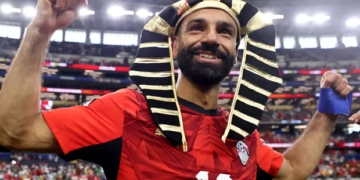





Why the Argentina vs Egypt World Cup Clash is More Than a Game
The upcoming World Cup fixture between Argentina and Egypt is generating a fever pitch across the continent, transcending the boundaries of a typical sporting event. When the Pharaohs step onto the pitch to face the defending world champions, it will not merely be a test of tactical acumen, but a defining moment for African football’s standing in the global hierarchy. This clash, inevitably framed around the individual brilliance of Mohamed Salah and Lionel Messi, carries the hopes of millions who view the pitch as one of the few arenas where the Global South can directly challenge and dismantle historical power structures.
For years, the narrative surrounding Messi and Salah has been heavily defined by their European club exploits and commercial dominance. However, the international stage strips away the immense financial backing of European super-clubs, leaving bare the raw developmental infrastructure of their respective nations. Egypt’s journey to this crucial knockout phase in the expanded tournament highlights a quiet revolution in North African football management. It is a testament to rigorous domestic coaching, improved scouting networks, and an increasingly sophisticated approach to sports science that is slowly taking root across the continent.
The significance of this match extends far beyond the ninety minutes of play. An Egyptian victory—or even a tactically commanding performance against the reigning champions—would serve as a powerful catalyst for the business of sports across Africa. Success on the world’s biggest stage directly influences global broadcast rights negotiations, attracts multinational sponsorships to local leagues, and accelerates infrastructure investments from governments eager to replicate that glory. When Egyptians dream of toppling Argentina, they are also envisioning a future where African talent is valued at a premium locally, rather than exported at a discount to foreign leagues.

On the pitch, the Argentina vs Egypt encounter presents a fascinating ideological contrast. The South Americans rely on a fluid, possession-heavy system orchestrated by their aging but brilliant talisman, designed to break down deep defensive blocks. In response, the Pharaohs have cultivated a pragmatic, transitional style that leverages defensive solidity and devastating counter-attacks. This tactical discipline proves that African teams are no longer just participants relying on physical prowess, but sophisticated tactical units capable of out-thinking traditional footballing aristocracies.
As the world tunes in, the implications for African youth are profound. Seeing an African nation stand toe-to-toe with global giants reinforces a narrative of capability and excellence that extends well beyond sports. It challenges outdated global stereotypes and demands equity in how African institutions are perceived. Whatever the final scoreline reads when the referee blows the final whistle, this World Cup fixture has already shifted the baseline of expectations. For African football, the era of being satisfied with merely qualifying is definitively over; the era of demanding a seat at the head of the table has arrived.