




The Emerging Market Blueprint: What Kyrgyzstan’s New Tamchy SFIT Financial Hub Signals for Global Capital Flow
As the global economy navigates geopolitical fragmentation and shifting trade corridors, emerging markets are increasingly rejecting the role of passive observers. Instead, they are actively constructing their own financial architectures to attract international capital. The recent inauguration of the Tamchy Special Financial Investment Territory (SFIT) by Kyrgyz President Sadyr Japarov on the shores of alpine Lake Issyk-Kul offers a compelling blueprint for how developing nations are rethinking economic integration.
While the launch of a financial hub in Central Asia might seem distant from Africa, the underlying strategy is deeply relevant to any emerging economy seeking to leapfrog traditional development hurdles. From Kigali to Port Louis, the race is on to create jurisdictions that combine regulatory independence with unhindered market access.
The Architecture of Trust
At the core of the Tamchy SFIT experiment is a recognition that international capital does not merely seek high returns; it demands legal certainty. Operating on the principles of English common law, the jurisdiction features an independent court, an International Dispute Resolution Centre, and a single-window digital registrar.
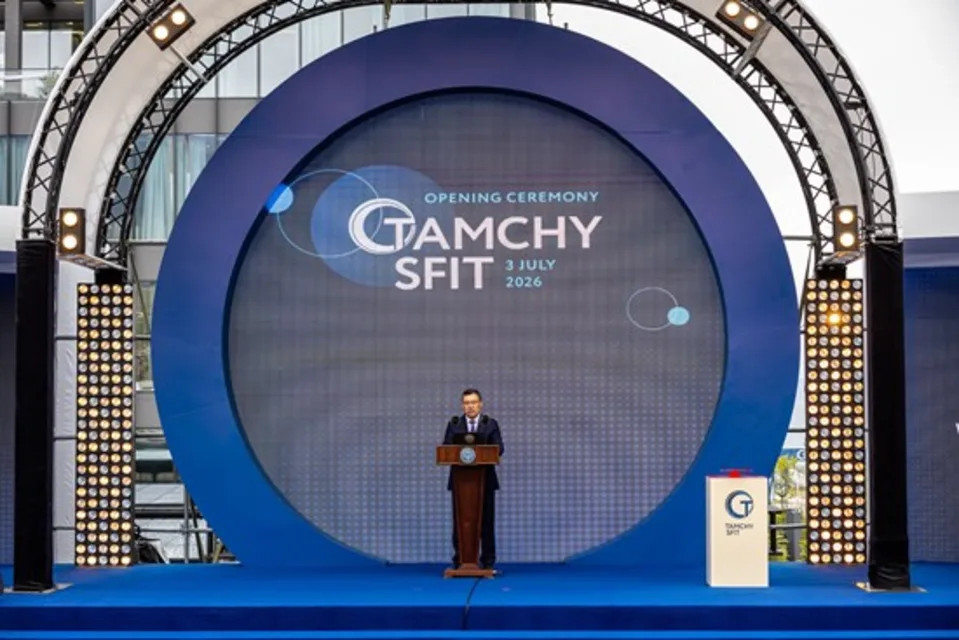
By guaranteeing a 0% tax rate on profits, dividends, and capital gains for 49 years, alongside 100% foreign ownership and unrestricted profit repatriation, Kyrgyzstan is directly challenging established financial centers. However, as Ali Ijaz Ahmad, First Deputy Chairman of the Tamchy SFIT Management Council, noted, the true draw is neutrality and stability. Positioned at the intersection of five Eurasian Economic Union (EAEU) economies, the territory serves as a trusted, flexible platform for businesses navigating complex regional markets.
This focus on institutional trust was echoed by early investors from South Korea, Switzerland, and the UAE. Seo Dong Hyun, CEO of Serim, highlighted that legal certainty is the foundation of long-term foreign direct investment. His observation that a project of this scale was delivered in just one year demonstrates the agility that emerging markets can leverage over slower, heavily bureaucratized developed nations.
Speed and Strategic Infrastructure
Beyond legal frameworks, the physical execution of the Tamchy SFIT reflects a growing understanding that financial centers must also be highly livable commercial ecosystems. Covering 6,000 hectares, the territory already features a fully operational business center, with proximity to the Issyk-Kul International Airport and premium hotels and residential developments under construction.
The ambitious targets—attracting 4,000 resident companies, creating 10,000 jobs, and contributing $20 billion to the national economy by 2035—underscore how specialized economic zones can rapidly accelerate macroeconomic transformation. For nations in the Global South, the lesson is clear: capital will flow to where it is treated best, protected rigorously, and allowed to operate without friction.
What This Means for the Global South

The success of the Tamchy SFIT will ultimately depend on consistent implementation and the shielding of its independent regulator from domestic political shifts. Yet, its rapid establishment proves that developing nations do not have to wait decades to build competitive financial ecosystems.
By importing world-class regulatory standards and marrying them with aggressive tax incentives and strategic geography, emerging markets can rewrite the rules of global investment. For African policymakers and economists observing this space, Kyrgyzstan’s bold move serves as both an inspiration and a competitive warning.
Disclaimer: This article is an independent policy analysis based on recent global financial developments and comparative international economic models. It is intended to encourage informed public discussion and does not necessarily reflect the editorial position of Afrikeye.