




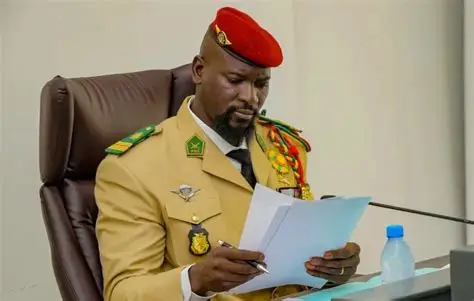
The Guinea raw gold export ban, announced on June 19 by President Mamadi Doumbouya, marks a decisive break from decades of shipping the country’s mineral wealth abroad unrefined. Doumbouya declared that raw gold would no longer be permitted to leave the country under any circumstances. The decision puts West Africa’s second-largest gold reserve holder firmly in the camp of a continent losing patience with exporting raw wealth and importing refined value.
Doumbouya made the announcement at a gathering of industrial and artisanal gold producers and gold buying offices, a session later broadcast on state-owned Radio Télévision Guinéenne. He was direct about the arrangement his country had been living with for too long: Guinea holds the second-largest gold reserves in West Africa, yet its gold left daily in raw form to be processed, certified, and sold elsewhere. That, he said, was finished.
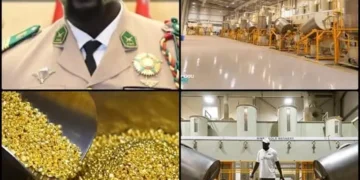
Under the new framework, all gold whether mined industrially, semi-industrially, or by artisanal operators must be smelted, certified, and processed domestically before reaching international markets. Authorities will channel production through the Nimba Gold Refinery, currently being installed in Gbessia, a district of the capital Conakry. Any operator that continues to ship unrefined gold after the Guinea raw gold export ban will face license suspension and the immediate termination of their mining contract.
According to Guinea’s Ministry of Mines and Geology, combined gold exports across all operators reached 22,142 kilograms in the first quarter of this year alone. Full-year figures for 2025 showed 19,946 kilograms from industrial miners and 49,609 kilograms from artisanal operators. Every kilogram of that volume will now be required to pass through the Conakry refinery before any export is authorised.
Guinea is best known internationally as the world’s largest bauxite producer, but its mining and business landscape has grown increasingly strategic. The Guinea raw gold export ban puts immediate pressure on Société Aurifère de Guinée, the AngloGold Ashanti subsidiary that ranks among the country’s largest industrial gold producers. The World Gold Council ranks Guinea as Africa’s sixth-largest gold producer overall a position that reflects how much value the country has historically surrendered by exporting the metal in its rawest, lowest-value form.
Guinea Raw Gold Export Ban Joins Africa’s Push to Keep Mineral Wealth at Home
The gold policy extends an approach Doumbouya has applied across Guinea’s mineral sector since 2022, when the government began pressing bauxite producers to honour commitments to build alumina refineries domestically. Last year, his government seized 51 mining concessions covering bauxite, gold, diamonds, graphite, and iron ore, citing inactivity and non-compliance with Guinea’s mining code a move that prompted several affected companies to file international arbitration claims.
The continent is watching Conakry’s decision because it is far from isolated. Zimbabwe moved along similar lines earlier this year, suspending exports of lithium concentrates and pressing for greater domestic processing and tighter control over mineral revenues. Zimbabwe had already banned the export of lithium ore in 2022 and announced a halt to lithium concentrate exports from January 2027, before imposing that ban with immediate effect in February 2026. Mali and Burkina Faso have separately launched projects to build their own gold refineries. The logic threading through all these decisions is identical: African governments are done being the raw material end of a global value chain that processes, brands, and sells their own resources back to them at a premium.
This pattern speaks directly to the ambitions underpinning Africa’s political and governance frameworks. The African Union’s Agenda 2063 explicitly calls for structural transformation away from raw commodity dependence. The African Continental Free Trade Area offers the institutional scaffolding to build intra-African processing corridors networks that refining hubs like Conakry could anchor for the wider West African subregion. The AU’s Africa Mining Vision, adopted in 2009, placed domestic beneficiation at the centre of the continent’s resource governance agenda.
Doumbouya’s position is that Guinea earns a fraction of the final value of its minerals by exporting them unprocessed a pattern the Guinea raw gold export ban now targets in a second major commodity, after bauxite. The World Bank ranks Guinea Africa’s fastest-growing economy in 2026 at 8.8%, lifted by a bauxite and iron-ore boom centred on the giant Simandou project. The gold refining push is designed to deepen that growth rather than let it remain a single-commodity story.
Real constraints will determine whether the policy delivers its promise. Legal analysts at international firm Gowling WLG noted in a January assessment that reliable baseload electricity has been a persistent barrier to Guinea’s domestic mineral processing ambitions. A refinery without consistent power is a building, not a production facility. Zimbabwe’s experience offers a cautionary parallel: critics there argued that the push to refine should have come sooner, since Zimbabwe had already lost years of value-added revenues while processing infrastructure lagged behind policy intention.
For those tracking African tech and industrial development, Guinea’s move is a data point in an accelerating continental experiment in which governments are forcing industrial upgrading through export restrictions rather than waiting for private investment to arrive organically. Whether the Guinea raw gold export ban succeeds will depend on the speed of the Nimba refinery’s operationalisation, the enforcement capacity of the Ministry of Mines, and the government’s willingness to hold firm when major operators push back through arbitration or deliberate production slowdowns.
The first certified gold ingot to leave Conakry under the new rules will be the real measure of this policy. Until then, every tonne of gold sitting in Guinean soil is a statement about how much the country intends to keep of what was always its own.