




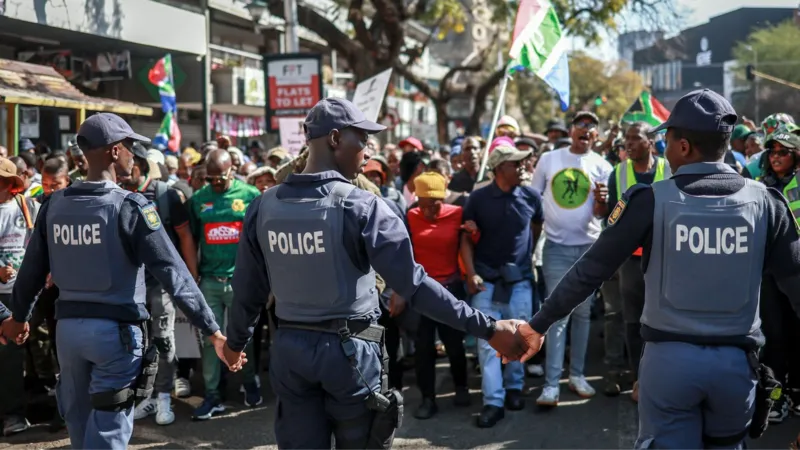
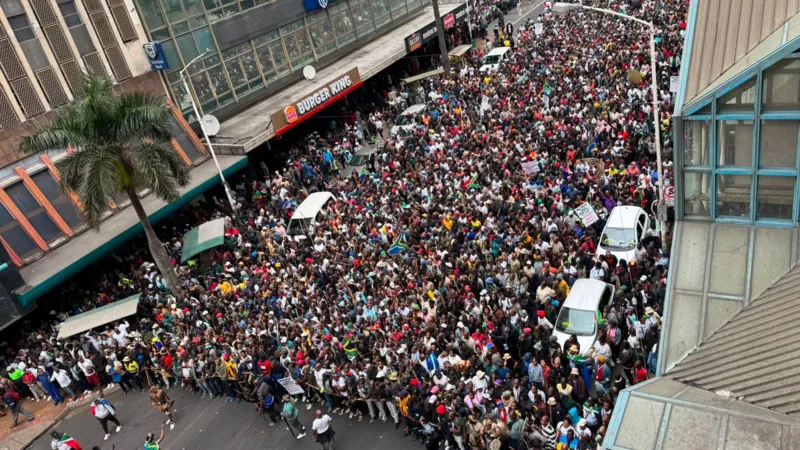
Tens of thousands of South Africans took to the streets on Tuesday as a self-imposed deadline for undocumented migrants to leave the country expired, with heavy police deployment across major cities aimed at preventing the xenophobic protests in South Africa from turning violent. Coordinated marches unfolded in Johannesburg, Pretoria and Durban, organised by groups demanding the mass removal of foreign nationals without legal status.
Police, backed by private security, fanned out across city centres after weeks of rising tension. Isolated looting was reported in Johannesburg’s Soweto township and in KwaZulu-Natal, where roughly ten people were arrested. In Germiston, demonstrators went door to door evicting residents suspected of being foreign nationals and handing them to police for document checks. Most marches passed off peacefully, with police confirming only a single machete seized in Durban, even as Al Jazeera reported fear still gripping migrant communities just hours before the deadline took effect.
The protests are the culmination of a campaign running since March, led primarily by two organisations: March and March, founded by former radio presenter Jacinta Ngobese-Zuma, and Operation Dudula, a longer-running vigilante movement now registered as a political party, according to its Wikipedia entry. Both groups blame undocumented migrants for unemployment, strained public services and crime, and both set 30 June as the date by which foreigners without papers were expected to be gone. South Africa’s unemployment rate stood above 32% in early 2026 after the country shed 350,000 jobs, conditions CNN reports have made migrants an easy target for grievances rooted in deeper structural failures.
The scale of departures has been significant. South African police say roughly 25,000 undocumented migrants have already been repatriated, the large majority from elsewhere on the continent. Malawi alone has flown or bused home around 7,000 of its citizens, while Nigeria evacuated 269 more on the eve of the deadline, bringing its total to about 600. Ghana, Mozambique and Zimbabwe have run similar repatriation operations as fear spread through informal settlements, with the Christian Science Monitor documenting families camped outside consulates in Cape Town awaiting evacuation. In Durban, temporary camps housing mostly Malawian families were dismantled as the deadline approached, with women and children waiting in line to board buses home.
President Cyril Ramaphosa met protest leaders the day before the marches in an effort to defuse tensions, and used his weekly newsletter to draw a line between lawful and unlawful migrants. “Some foreign nationals who live in South Africa are here lawfully,” he wrote, adding that the right to protest “does not allow people to threaten or intimidate others, or to engage in acts of vandalism or violence.” His government has also moved to fast-track deportations of undocumented arrivals, a response rights groups say has not gone far enough to curb vigilante violence.
Migrants caught in the crackdown describe a country they no longer feel safe in. One Malawian who travelled to South Africa for work said he had been called “makwerekwere” — a xenophobic slur directed at African migrants — and accepted he had no choice but to return home. Another, still waiting to be processed at a transit camp, appealed for unity rather than division, saying Africa “can’t be Africa without South Africa… without Malawi, without anywhere,” and urging South Africans and migrants alike to stay united as one continent.
Why Xenophobic Protests in South Africa Are a Pan-African Concern
The crisis is not contained within South Africa’s borders. More than three million documented foreign nationals live in the country, the large majority from neighbouring African states that depend on remittances and labour mobility under regional frameworks tied to the Southern African Development Community. Governments across the continent — from Lagos to Lilongwe — have had to divert diplomatic and logistical resources into emergency repatriation flights, an unplanned cost that underscores how a domestic policy failure in one country can ripple into a continental humanitarian response, with knock-on effects for African economies and trade flows more broadly.
The episode also tests South Africa’s commitments under the African Union’s free movement protocols and the broader spirit of Agenda 2063, which envisions integration and labour mobility as engines of African prosperity. Researchers writing for The Conversation argue that the playbook used by Operation Dudula and March and March — channelling legitimate economic grievances into hostility toward fellow Africans — echoes patterns seen in earlier waves of South African xenophobia, including the 2008 riots that killed more than 60 people. Xenowatch, the African Centre for Migration and Society’s violence tracker, has already recorded two deaths linked to this year’s unrest.
For other African governments managing their own informal labour migration and border pressures, the South African case is a cautionary one: unresolved unemployment and service delivery failures, left unaddressed, can curdle into movements that target migrants rather than the policies that failed citizens in the first place. It is a dynamic Afrikeye has tracked closely across the continent’s politics and business coverage, where labour migration and economic anxiety repeatedly intersect, and one that touches on broader African affairs Afrikeye follows daily.
What happens next will depend largely on whether March and March follows through on its promise to keep protesting weekly, and whether Ramaphosa’s government can show it is enforcing immigration law without tolerating mob justice. Regional governments will also be watching closely to see whether repatriation flows ease tensions or simply pause them until the next flashpoint, a story line worth following alongside the continent’s wider travel and mobility trends.