





The Ugandan Ministry of Foreign Affairs, in partnership with the Ministry of Finance, Planning, and Economic Development, concluded an intensive strategic review to accelerate trade and investment across the Gulf and Middle East regions. Held in Istanbul, Türkiye, from June 21 to 25, 2026, this high-level retreat utilized proactive commercial diplomacy to gather regional heads of missions and streamline state marketing strategies. The collaborative forum focused on evaluating institutional performance, eliminating communication gaps, and maximizing capital inflows through targeted commercial diplomacy for the upcoming 2026/27 fiscal year.
The conference operated under a clear mandate to activate structural interventions in commercial diplomacy, transforming foreign embassies into proactive economic hubs. Delegations from key regional stations—including Riyadh, Doha, Abu Dhabi, Dubai, and Ankara—reviewed their current market outreach activities to align directly with state development goals. Ambassador Henry Mayega, Head of the International Economic Cooperation Department, emphasized that improved institutional funding from the treasury means missions must prioritize verifiable targets that yield tangible economic outcomes.
This calculated repositioning of foreign outposts heavily impacts Uganda’s domestic business sector by opening direct, high-value supply lines into competitive, wealthy Middle Eastern markets. Historically, fragmented reporting and limited engagement with private sector stakeholders slowed down bilateral trade agreements and isolated local exporters. By establishing unified communication channels, the state ensures that corporate investors can navigate domestic regulations smoothly, accelerating project deliveries and strengthening cross-border corporate partnerships.
Integrating National Trade Initiatives via the New Commercial Diplomacy Hub
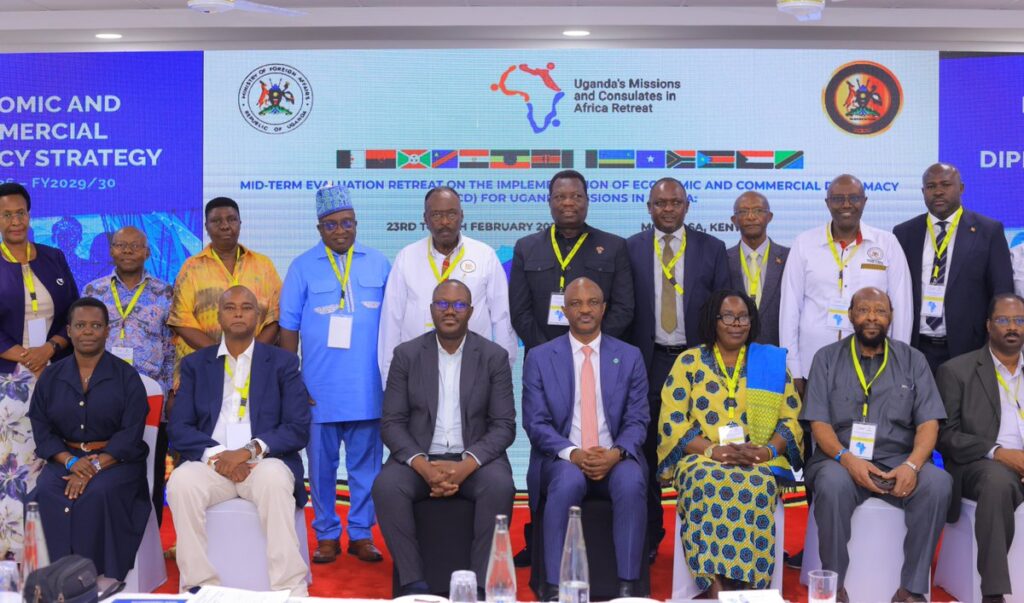
To resolve ongoing logistical bottlenecks, the ministry has centralized its promotional campaigns under a newly established Economic and Commercial Diplomacy Hub. Ambassador Richard Kabonero, head of the specialized division, explained that training initiatives are underway to equip foreign envoys with real-time investment data. Kabonero stated that aligning active embassy work plans with Uganda’s Ten-fold Growth Agenda, the Fourth National Development Plan, and Vision 2040 is essential to drive tourism, secure manufacturing capital, and stimulate long-term sub-regional growth.
The successful rollout of these target-driven diplomatic frameworks is opening up thousands of highly specialized public sector jobs and consulting roles across the country’s macro-governance landscape. As trade offices expand their operations, the demand for qualified trade analysts, bilingual legal counselors, and investment relations managers is rising steadily. This targeted workforce expansion ensures that state embassies can transition successfully from traditional political centers into high-performing commercial entities capable of sustaining regional economic competitiveness.
The strategic focus of the Middle East sessions was further supported by an in-depth economic presentation delivered by Mr. Joseph Enyimu, Commissioner for Economic Policy Development and Research at the Ministry of Finance. Hosting the assembly in Istanbul, H.E. Nusura Tiperu, Uganda’s Ambassador to Türkiye, praised the seamless coordination between financial and foreign ministries, noting that Istanbul’s unique geographic position connecting Asia, Europe, and the Middle East makes it a premier logistical center to evaluate global trade progress.
The structural evaluation concluded a global series of regional reviews conducted earlier this year for missions across Africa, Asia, the Pacific, Europe, and the Americas. To support these expanding cross-border initiatives, administrative teams are introducing advanced information portals within the country’s growing tech sector to distribute updated investment profiles securely. This digital integration allows diplomatic corps to provide real-time market data to global investors, matching the transparent, data-driven management models utilized by the Africa CDC emergency registry to handle regional structural challenges.
Independent macroeconomic consultants sharing their professional opinion columns emphasize that diplomatic declarations must run parallel to aggressive domestic agricultural and infrastructural reforms to deliver meaningful results. They argue that foreign interest in premium exports can only be sustained if local supply chains remain stable, clean, and highly reliable. Incorporating advanced predictive data models and specialized ai resource mapping can help domestic producers optimize harvesting lines ahead of seasonal export windows, protecting national health standards while securing an elite position in global food security corridors.