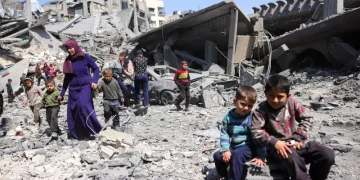





Nine days after a temporary ceasefire took hold, the situation in Gaza remains deeply uncertain, as renewed Israeli airstrikes impact multiple regions and raise fears of a full-scale war. The fragile truce, initially seen as a rare glimmer of hope for civilians, now hangs by a thread amid growing Israeli-Palestinian tensions.
Ceasefire Breakdown Feared Amid New Bombings
Ismail Baba, a father of four from Beit Lahiya in northern Gaza, has been displaced 11 times since the outbreak of war. When the ceasefire began last week, he hoped for a moment of peace—however short-lived. But that sense of relief shattered early Sunday morning when airstrikes once again lit up the skies.
“I felt the end of the false sense of safety we were clinging to. We had barely started to move freely between areas again, and now we are back to fear and caution,” Baba told Al Jazeera.
The ceasefire breakdown conflict stems from deep disagreements over the implementation of the second phase of a U.S.-drafted truce plan, designed to lead to a permanent end to hostilities. While the first phase enabled the release of some hostages and allowed limited movement for civilians, ongoing skirmishes have kept the situation volatile.
Deaths Mount as Airstrikes Resume
On Saturday, Gaza City witnessed the burial of 11 members of the Abu Shabaan family, killed when their vehicle crossed an unmarked Israeli withdrawal line. Two shells fired by Israeli tanks killed all aboard, including seven children.
“Shreds, shreds, they are in shreds. All of them. They are torn to pieces. I don’t know if I am saying goodbye to my son or my daughter,” said Umm Mohammed Shaaban, mourning her family at the funeral.
This incident underscores the grim reality on the ground, where maps and lines mean little amid shifting combat zones. Israeli officials have since announced they will mark operational zones with concrete blocks to prevent further civilian casualties.
One mourner told Al Jazeera, “The truce is fragile, the truce is on paper. On the ground, we are dying. This is the reality, this is the truce. It is a truce coloured in red, it is all blood.”
Humanitarian Crisis Deepens in Gaza
With nearly half of Gaza still under Israeli military control, the ongoing violence continues to worsen the humanitarian crisis Gaza faces. Many residents are struggling with food shortages, displacement, and a lack of basic necessities. Baba and others worry that continued violence could completely unravel the ceasefire and reignite a full-blown war.
“I hope the ceasefire continues, and that our social, economic and political life improves so that one day we can return to our homeland,” Baba said. “I know the north has become a disaster zone, unfit for living, yet we still have the will to rebuild and start again. This can only happen if the ceasefire holds.”
Despite renewed attacks, hope remains among Palestinians that an agreement can still be reached. But as strikes continue and uncertainty grows, many fear this moment of calm is rapidly slipping away.
For those affected, the ceasefire is not just a diplomatic tool—it’s a lifeline, fraying by the hour.
Planning a trip amid the turmoil? Check out our travel booking site for future plans when peace returns.
This story was first reported by Al Jazeera. Read the full article here.